 よみうち英語Read the classics by typing
Notes Scene 36: Across the Meadows
You've finished this scene
Notes on this scene
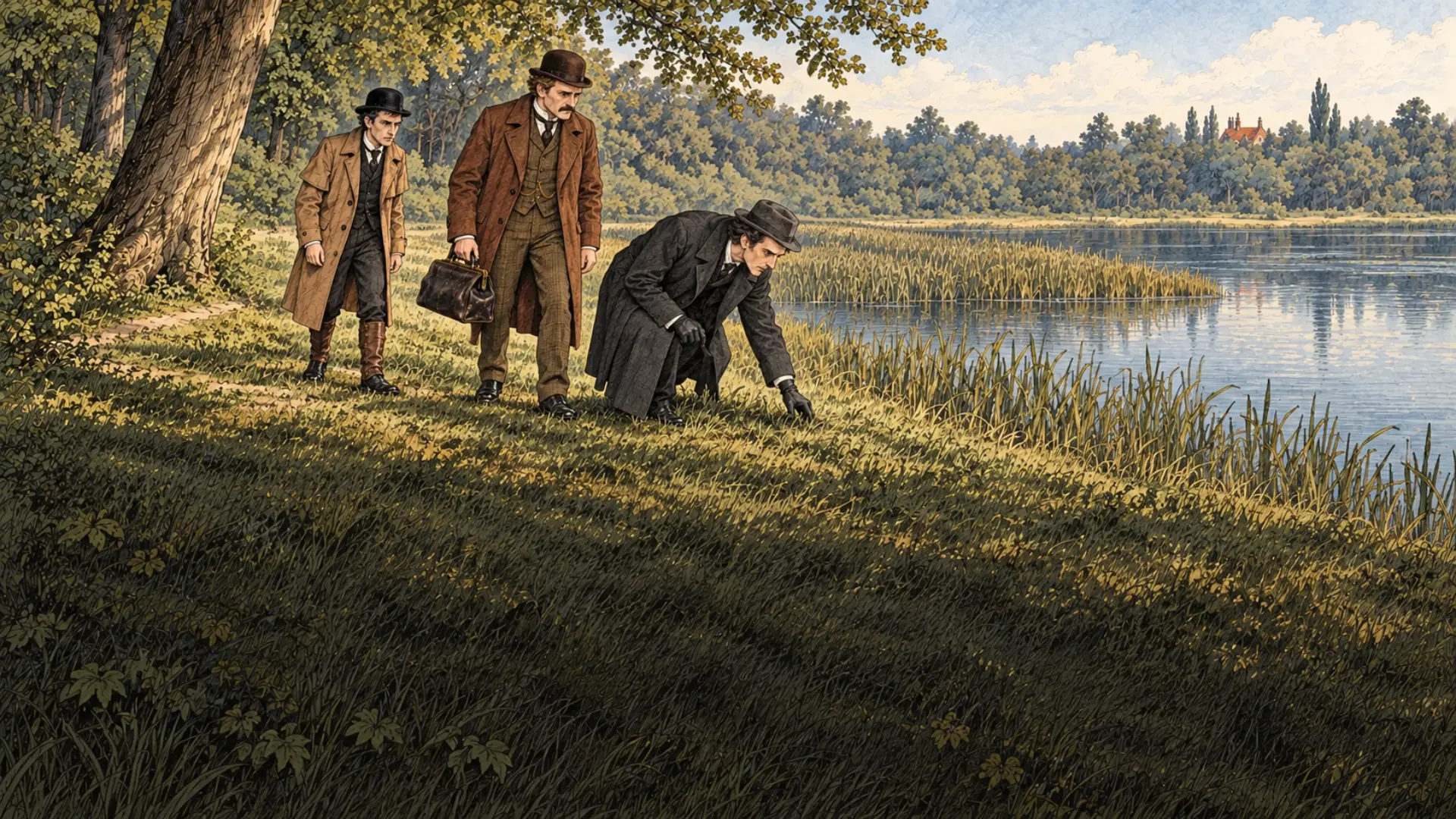
Holmes becomes intensely alert while pursuing the trail, concentrating so fully that questions barely reach him. He moves rapidly along the damp path, sometimes stopping or making a detour. Lestrade follows with apparent indifference and contempt. Watson, convinced that each movement has a purpose, watches his friend with sustained interest instead.
Japanese in this scene
- 彼しか知らない人
- しか with a negative means ‘only.’ The phrase describes people familiar only with Holmes as a quiet thinker, and therefore unprepared for the energetic investigator they would see here.
- 耳には入らず
- 耳に入る can mean to register or be heard. 入らず is a written negative linking form equivalent to 入らないで. With は, it emphasizes that words fail to reach Holmes's attention.
- 急ぐかと思えば
- 〜かと思えば introduces a quick or striking change: just when one thinks he is hurrying, he suddenly stops. It helps Watson depict Holmes's unpredictable pattern of movement.
Full text: original English and Japanese translation
Sherlock Holmes was transformed when he was hot upon such a scent as this. Men who had only known the quiet thinker and logician of Baker Street would have failed to recognise him. His face flushed and darkened. His brows were drawn into two hard black lines, while his eyes shone out from beneath them with a steely glitter. His face was bent downward, his shoulders bowed, his lips compressed, and the veins stood out like whipcord in his long, sinewy neck. His nostrils seemed to dilate with a purely animal lust for the chase, and his mind was so absolutely concentrated upon the matter before him that a question or remark fell unheeded upon his ears, or, at the most, only provoked a quick, impatient snarl in reply. Swiftly and silently he made his way along the track which ran through the meadows, and so by way of the woods to the Boscombe Pool. It was damp, marshy ground, as is all that district, and there were marks of many feet, both upon the path and amid the short grass which bounded it on either side. Sometimes Holmes would hurry on, sometimes stop dead, and once he made quite a little detour into the meadow. Lestrade and I walked behind him, the detective indifferent and contemptuous, while I watched my friend with the interest which sprang from the conviction that every one of his actions was directed towards a definite end.
こうした手掛かりを熱心に追うとき、シャーロック・ホームズは別人のようになった。ベイカー街の静かな思索家、論理家としての彼しか知らない人には、同じ人物と分からなかっただろう。顔は紅潮し、色が濃くなった。眉は二本の硬く黒い線のように寄せられ、その下から目が鋼のようにきらめいていた。顔をうつむけ、肩をかがめ、唇を引き結び、長く筋張った首には、鞭の紐のように血管が浮き出ていた。鼻孔は、まさに獣のような狩りへの欲求で広がって見えた。心は目の前の事柄に完全に集中していて、質問や言葉をかけても耳には入らず、せいぜい、素早くいら立ったうなり声のような返事を引き出すだけだった。彼は、牧草地を抜ける小道を素早く黙々と進み、林を通ってボスコム池へ向かった。この地方一帯と同じく、そこは湿った沼地のような地面で、小道にも、その両側を縁取る短い草の間にも、たくさんの足の跡があった。ホームズは急ぐかと思えば、ぴたりと立ち止まり、一度は牧草地へかなり回り道をした。レストレードと私はその後ろを歩いた。捜査官は無関心で、軽蔑したような様子だったが、私は、友人の行動の一つ一つがはっきりした目的に向けられているという確信から、興味を持って見ていた。