 よみうち英語Read the classics by typing
Notes Scene 38: The Examination Continues
You've finished this scene
Notes on this scene
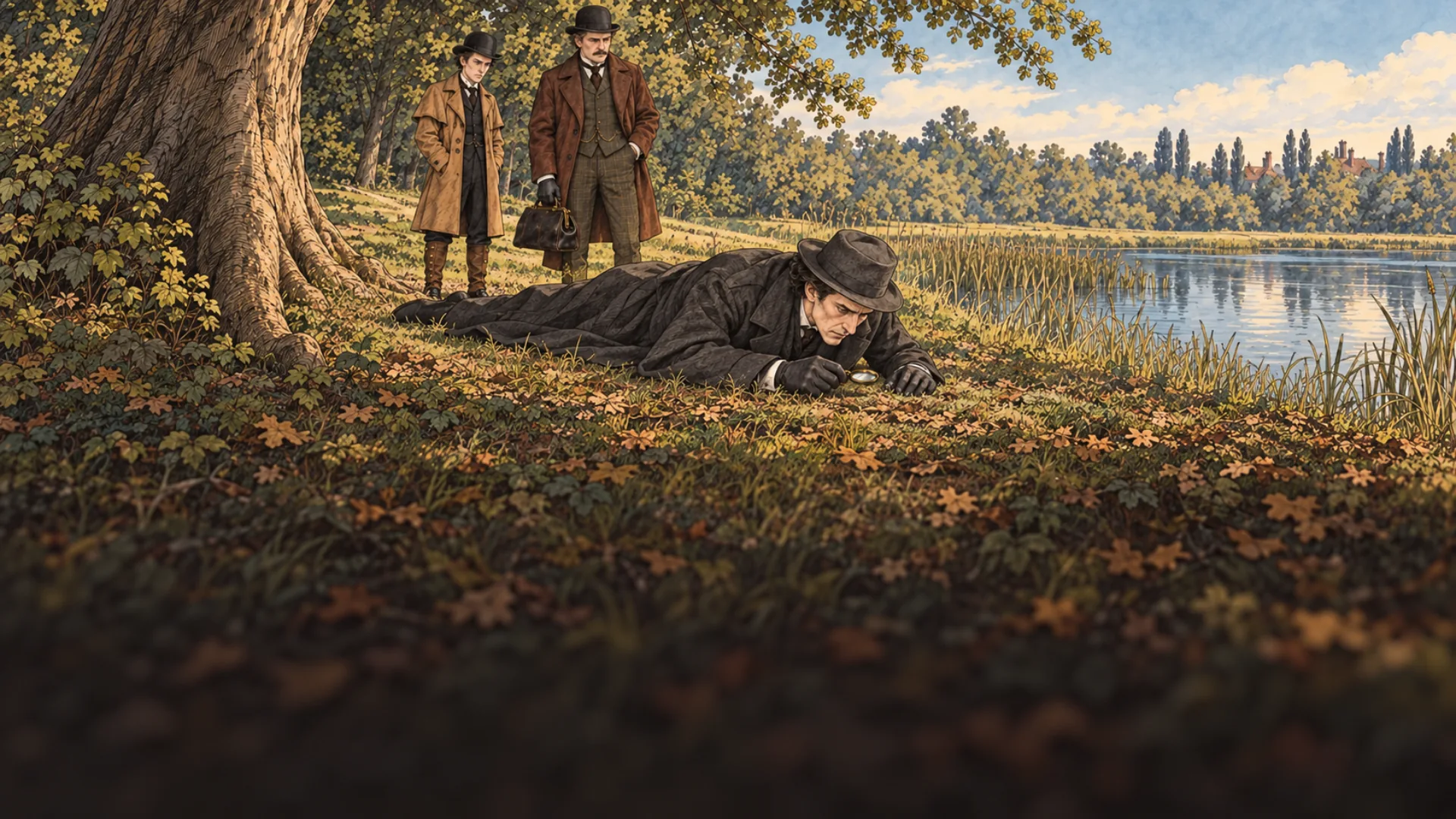
Holmes identifies Lestrade's distinctive tracks and complains that the search party has obscured much of the ground. Still, he finds three separate passages by the same feet. Using his magnifying glass, he distinguishes James's walking and running tracks, his father's movements, and the mark left by the gun while the son stood listening.
Japanese in this scene
- モグラでもたどれる
- でも after a noun can mean ‘even.’ Holmes exaggerates the obviousness of the tracks by saying that even a mole could follow them. This でも is not the conjunction ‘but.’
- どんなに簡単だったことか
- どんなに…ことか forms an exclamation about degree: ‘how easy it would have been!’ The preceding conditional imagines Holmes arriving before the ground was disturbed, so it is a regretful hypothetical.
- というより
- ‘Rather than’ or ‘more accurately.’ Watson revises his first description: Holmes is speaking less to his companions than to himself. The phrase refines an expression rather than making a numerical comparison.
Full text: original English and Japanese translation
"Oh, tut, tut! I have no time! That left foot of yours with its inward twist is all over the place. A mole could trace it, and there it vanishes among the reeds. Oh, how simple it would all have been had I been here before they came like a herd of buffalo and wallowed all over it. Here is where the party with the lodge-keeper came, and they have covered all tracks for six or eight feet round the body. But here are three separate tracks of the same feet." He drew out a lens and lay down upon his waterproof to have a better view, talking all the time rather to himself than to us. "These are young McCarthy's feet. Twice he was walking, and once he ran swiftly, so that the soles are deeply marked and the heels hardly visible. That bears out his story. He ran when he saw his father on the ground. Then here are the father's feet as he paced up and down. What is this, then? It is the butt-end of the gun as the son stood listening.
「ああ、まあ、まあ。時間がないのだ。内側へねじれたきみの左足の跡が、そこらじゅうにある。モグラでもたどれる。ほら、あそこでは葦の間へ消えている。ああ、彼らが水牛の群れのように来て、そこらじゅうを踏み荒らす前に私が来ていれば、どんなに簡単だったことか。ここは門番と一緒の人たちが来た所で、遺体の周り六、八フィートの範囲では、あらゆる跡を覆ってしまっている。だが、ここには同じ足による三筋の別々の跡がある」彼は拡大鏡を取り出し、もっとよく見るため、防水外套の上に横たわった。その間じゅう、私たちにというより、独り言のように話していた。「これは若いマッカーシーの足跡だ。二度は歩き、一度は速く走っている。そのため、靴底の前のほうは深く刻まれ、かかとはほとんど見えない。彼の話を裏付けている。父親が地面に倒れているのを見て、走ったのだ。次に、こちらは行ったり来たりした父親の足跡だ。では、これは何だ。息子が立って話を聞いていたときの、銃床の先の跡だ。