 よみうち英語Read the classics by typing
Notes Scene 5: Across the Street
You've finished this scene
Notes on this scene
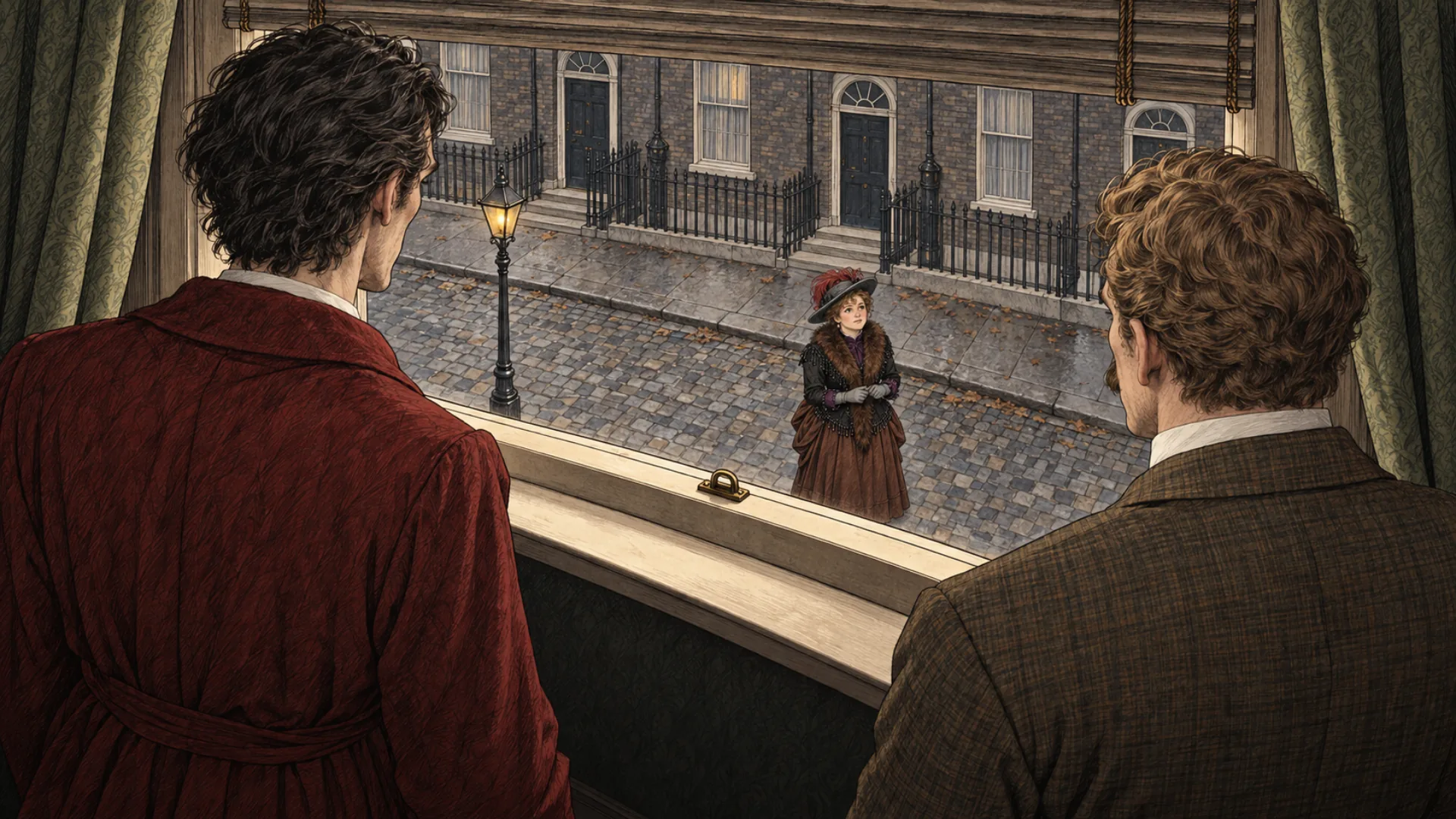
The woman across the street watches the window in agitation before crossing the road and ringing the bell. From her movements, Holmes judges that she brings a romantic problem marked by uncertainty and sorrow rather than the firm anger of someone seeking revenge.
Japanese in this scene
- は
- は marks the topic of the sentence and can also contrast it with another topic. It is written ha but normally pronounced wa.
- が
- が marks the grammatical subject or introduces newly focused information. It can also connect clauses with a mild contrast.
- を
- を marks the direct object of a verb. With a movement verb, it can instead mark the route or place being crossed.
- に
- に can mark a destination, target, time, recipient, purpose, or resulting state. The predicate shows its role here.
Full text: original English and Japanese translation
He had risen from his chair and was standing between the parted blinds gazing down into the dull neutral-tinted London street. Looking over his shoulder, I saw that on the pavement opposite there stood a large woman with a heavy fur boa round her neck, and a large curling red feather in a broad-brimmed hat which was tilted in a coquettish Duchess of Devonshire fashion over her ear. From under this great panoply she peeped up in a nervous, hesitating fashion at our windows, while her body oscillated backward and forward, and her fingers fidgeted with her glove buttons. Suddenly, with a plunge, as of the swimmer who leaves the bank, she hurried across the road, and we heard the sharp clang of the bell.
彼は椅子から立ち、開いたブラインドの間に立って、くすんだ色のロンドンの通りを見下ろしていた。肩越しに見ると、向かいの歩道には大柄な女性がいた。首には厚い毛皮の襟巻きを巻き、デヴォンシャー公爵夫人風に、耳の上へ気を引くように傾けたつばの広い帽子には、くるりと巻いた大きな赤い羽根が付いていた。この大げさな装いの下から、彼女は落ち着かずためらうようにこちらの窓を見上げていた。体を前後に揺らし、指では手袋のボタンをもじもじといじっていた。突然、岸を離れる泳ぎ手のように思い切ると、彼女は急いで道を渡り、鋭い呼び鈴の音が聞こえた。
"I have seen those symptoms before," said Holmes, throwing his cigarette into the fire. "Oscillation upon the pavement always means an affaire de cœur. She would like advice, but is not sure that the matter is not too delicate for communication. And yet even here we may discriminate. When a woman has been seriously wronged by a man she no longer oscillates, and the usual symptom is a broken bell wire. Here we may take it that there is a love matter, but that the maiden is not so much angry as perplexed, or grieved. But here she comes in person to resolve our doubts."
「こういう兆候は前にも見たことがある」と、ホームズは煙草を暖炉へ投げ込みながら言った。「歩道で体を揺らしているのは、いつも恋愛の問題を意味する。助言は欲しいが、人に話すにはあまりに微妙なことではないかと迷っているのだ。それでも、ここでさらに見分けられることがある。男性にひどい仕打ちを受けた女性は、もう体を揺らして迷ったりはしない。その場合によく見られる兆候は、切れた呼び鈴の針金だ。今回は恋の問題だとしてよいが、女性は怒っているというより、困惑しているか、悲しんでいるのだろう。だが、疑問を解いてくれる本人が来たよ」