 よみうち英語Read the classics by typing
Notes Scene 26: A Question of Sleeves
You've finished this scene
Notes on this scene
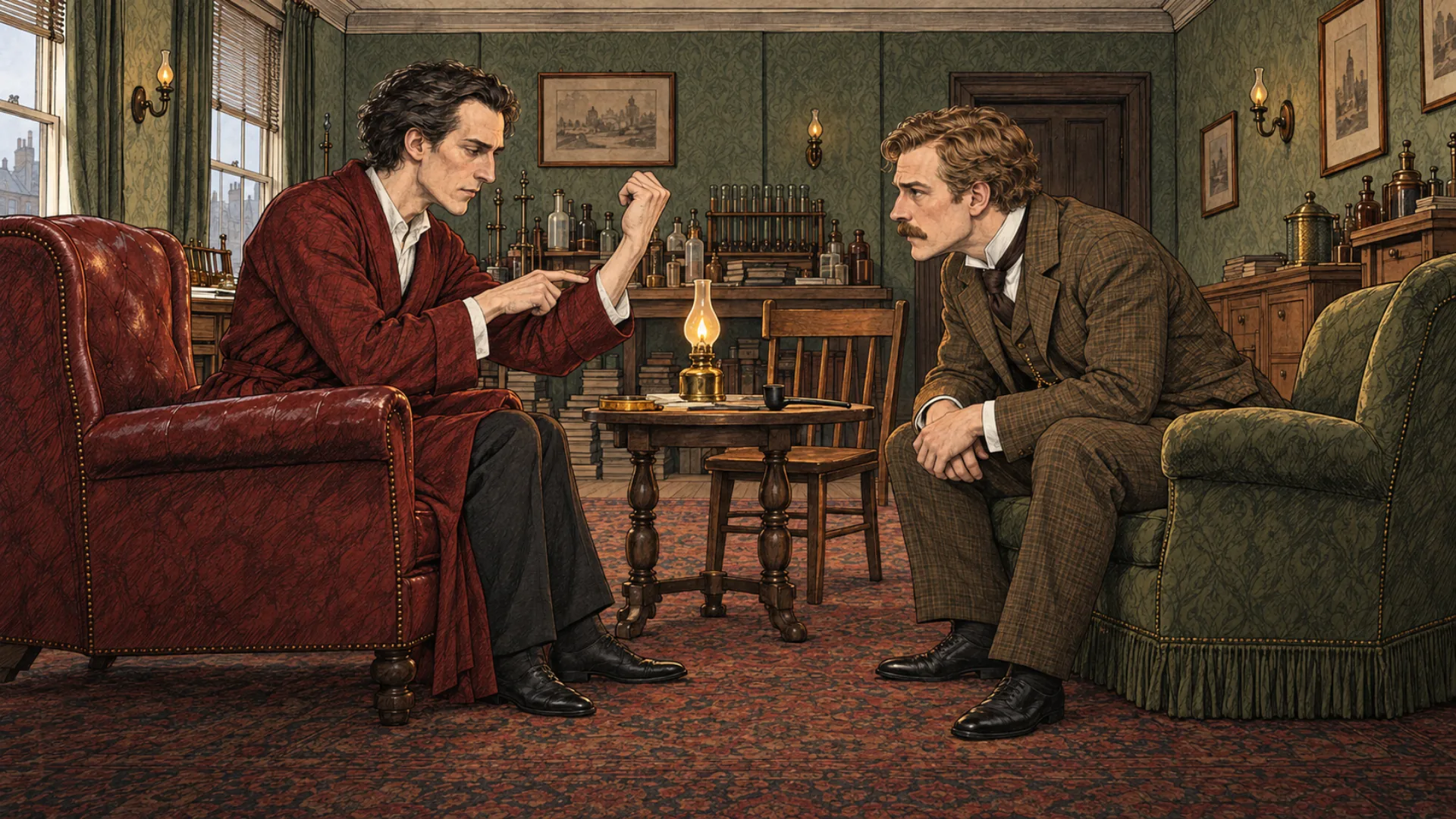
Holmes praises Watson’s attention while explaining that he overlooked the most useful evidence. Parallel marks on Mary’s sleeve reveal where it pressed against a typewriter, while the indentation of a pince-nez on her nose clearly confirms her short sight. Both clues support his conclusion.
Japanese in this scene
- は
- は marks the topic of the sentence and can also contrast it with another topic. It is written ha but normally pronounced wa.
- が
- が marks the grammatical subject or introduces newly focused information. It can also connect clauses with a mild contrast.
- を
- を marks the direct object of a verb. With a movement verb, it can instead mark the route or place being crossed.
- に
- に can mark a destination, target, time, recipient, purpose, or resulting state. The predicate shows its role here.
Full text: original English and Japanese translation
Sherlock Holmes clapped his hands softly together and chuckled.
シャーロック・ホームズはそっと両手をたたき、くすくす笑った。
"'Pon my word, Watson, you are coming along wonderfully. You have really done very well indeed. It is true that you have missed everything of importance, but you have hit upon the method, and you have a quick eye for colour. Never trust to general impressions, my boy, but concentrate yourself upon details. My first glance is always at a woman's sleeve. In a man it is perhaps better first to take the knee of the trouser. As you observe, this woman had plush upon her sleeves, which is a most useful material for showing traces. The double line a little above the wrist, where the typewritist presses against the table, was beautifully defined. The sewing-machine, of the hand type, leaves a similar mark, but only on the left arm, and on the side of it farthest from the thumb, instead of being right across the broadest part, as this was. I then glanced at her face, and, observing the dint of a pince-nez at either side of her nose, I ventured a remark upon short sight and typewriting, which seemed to surprise her."
「いやはや、ワトソン、きみは実に上達しているよ。本当に、たいへんよくやった。肝心なことは何もかも見落としているが、やり方はつかんだし、色を見る目も鋭い。全体的な印象を頼りにせず、きみ、細部に注意を集中したまえ。私はまず、いつも女性の袖を見る。男性なら、ズボンのひざを先に見たほうがよいかもしれない。きみも気づいたとおり、この女性の袖にはプラッシュがあった。跡を見せるのに、これほど都合のよい生地はない。タイピストが机に押しつける、手首から少し上のところに、二本の線がくっきり出ていた。手回し式のミシンでも似た跡は残るが、左腕だけで、しかも親指から最も遠い側に付く。今回のように、腕の最も幅の広い部分をまっすぐ横切ることはない。それから顔を見ると、鼻の両側に鼻眼鏡の押された跡があったので、思い切って近視とタイプの仕事の話をしてみた。彼女は驚いたようだったね」