 よみうち英語Read the classics by typing
Notes Scene 31: Putting Knowledge to Use
You've finished this scene
Notes on this scene
Holmes compares the mind to a room that should contain useful furniture, while reference knowledge can remain safely stored in books. He asks Watson for an encyclopedia and returns to the case, considering Elias’s departure from America and the three warning letters.
Japanese in this scene
- なければならない
- The pattern 〜なければならない expresses obligation: “must; have to.” It is built from the negative conditional form followed by ならない.
- という
- という links a quoted name, statement, or idea to the noun that follows. It can be translated as “called,” “that,” or “the idea that.”
- 最後
- 最後 is used here as noun. In this context it means “last.”
Full text: original English and Japanese translation
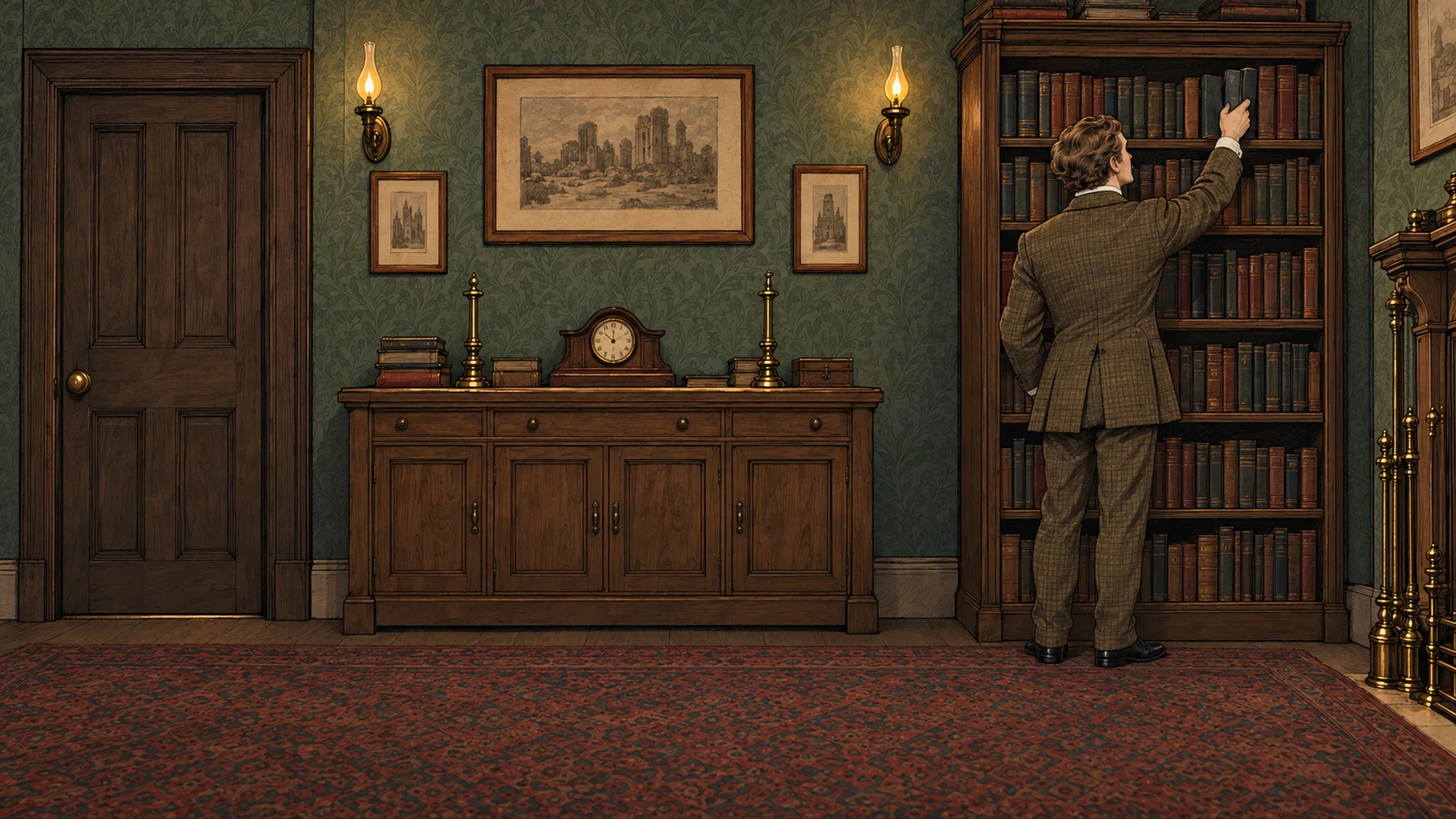
Holmes grinned at the last item. "Well," he said, "I say now, as I said then, that a man should keep his little brain-attic stocked with all the furniture that he is likely to use, and the rest he can put away in the lumber-room of his library, where he can get it if he wants it. Now, for such a case as the one which has been submitted to us to-night, we need certainly to muster all our resources. Kindly hand me down the letter K of the American Encyclopædia which stands upon the shelf beside you. Thank you. Now let us consider the situation and see what may be deduced from it. In the first place, we may start with a strong presumption that Colonel Openshaw had some very strong reason for leaving America. Men at his time of life do not change all their habits and exchange willingly the charming climate of Florida for the lonely life of an English provincial town. His extreme love of solitude in England suggests the idea that he was in fear of someone or something, so we may assume as a working hypothesis that it was fear of someone or something which drove him from America. As to what it was he feared, we can only deduce that by considering the formidable letters which were received by himself and his successors. Did you remark the postmarks of those letters?"
最後の項目に、ホームズはにやりとした。「さて」と彼は言った。「当時言ったことを、今も言うよ。人は頭という小さな屋根裏に、使いそうな家具をすべてそろえ、それ以外は図書室の物置にしまっておけばよい。必要になれば、そこから取り出せる。今夜持ち込まれたような事件では、持てる手段を総動員しなければならないのは確かだ。きみのそばの棚にある『アメリカ百科事典』のKの巻を取ってくれたまえ。ありがとう。さて、状況を考えて、そこから何を導けるか確かめよう。まず、オープンショー大佐にはアメリカを去る極めて強い理由があった、という有力な推定から始められる。あの年齢の人間は、よほどのことがなければ習慣を全部変え、快いフロリダの気候を、イギリスの地方町での孤独な暮らしと進んで取り替えたりはしない。イングランドであれほど孤独を好んだことから、誰か、または何かを恐れていたと考えられる。そこで、何者かへの恐怖がアメリカを去らせたという作業仮説を置ける。何を恐れていたのかは、本人と相続人たちが受け取った恐ろしい手紙を考えることでしか推論できない。あの手紙の消印には気づいたかい」