 よみうち英語Read the classics by typing
Notes Scene 2: A Homely Old Hat
You've finished this scene
Notes on this scene
Holmes explains that the shabby hat belongs to a curious but apparently innocent problem rather than a terrible crime. The scene establishes this development clearly and closes before the next step begins, preserving the original passage's order and the limits of what the characters know at this point.
Japanese in this scene
- 犯罪ではないのに人目をひく奇妙な小さな問題も
- In 犯罪ではないのに人目をひく奇妙な小さな問題も, のに contrasts what follows with the result normally expected from the preceding clause.
- 何かの謎を解き、何かの罪を罰するため
- The clause means “in order to solve some mystery and punish some crime.” Here ため follows the two verbs and marks the purpose that Watson imagines for the hat as a clue.
- これほど密集した人の群れが互いに作用し合えば
- In これほど密集した人の群れが互いに作用し合えば, ほど sets the degree or extent expressed by the surrounding description.
- とシャーロック・ホームズは笑いながら言った
- In とシャーロック・ホームズは笑いながら言った, ながら links the action before it with the action or state that follows.
Background
- four million human beings
- London was already one of the world's largest cities, with several million residents. Holmes argues that such a dense population naturally produces strange events even when no crime has occurred.
Full text: original English and Japanese translation
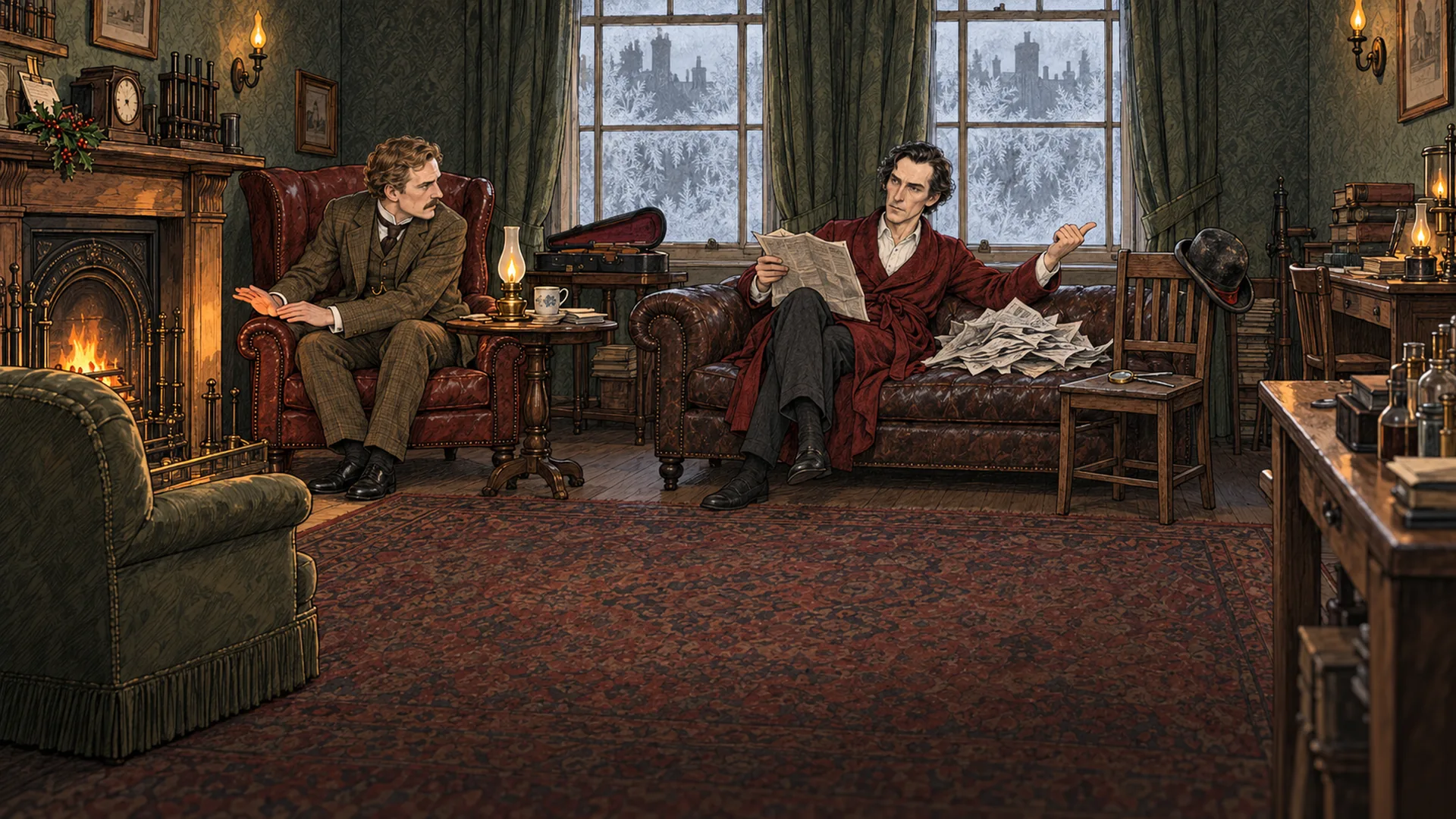
I seated myself in his armchair and warmed my hands before his crackling fire, for a sharp frost had set in, and the windows were thick with the ice crystals. "I suppose," I remarked, "that, homely as it looks, this thing has some deadly story linked on to it—that it is the clue which will guide you in the solution of some mystery and the punishment of some crime."
私は彼の肘掛け椅子に腰を下ろし、ぱちぱちと燃える暖炉の火で手を温めた。厳しい冷え込みが始まっていて、窓には氷の結晶がびっしりと張りついていたのだ。「思うに」と私は言った。「見たところありふれた帽子だが、これには何か恐ろしい話がからんでいるんだろう——何かの謎を解き、何かの罪を罰するための手がかりになるというわけだ」
"No, no. No crime," said Sherlock Holmes, laughing. "Only one of those whimsical little incidents which will happen when you have four million human beings all jostling each other within the space of a few square miles. Amid the action and reaction of so dense a swarm of humanity, every possible combination of events may be expected to take place, and many a little problem will be presented which may be striking and bizarre without being criminal. We have already had experience of such."
「いや、いや。罪などないよ」とシャーロック・ホームズは笑いながら言った。「ほんの数平方マイルの中で四百万もの人間が押し合いへし合いしていれば、どうしても起きてしまう、気まぐれでささいな出来事のひとつにすぎないのさ。これほど密集した人の群れが互いに作用し合えば、ありとあらゆる出来事の組み合わせが起こりうるし、犯罪ではないのに人目をひく奇妙な小さな問題も、いくらでも持ち込まれるだろう。そういう経験なら、私たちはもう何度もしてきたじゃないか」
"So much so," I remarked, "that of the last six cases which I have added to my notes, three have been entirely free of any legal crime."
「まったくだね」と私は言った。「私が記録に加えた最近の六つの事件のうち、三つは法律上の罪とはまるで無縁だったくらいだ」