 よみうち英語Read the classics by typing
Notes Scene 5: A Clue to the Owner
You've finished this scene
Notes on this scene
A tag and the initials H. B. fail to identify the owner, leaving the hat itself as the only useful clue. The scene establishes this development clearly and closes before the next step begins, preserving the original passage's order and the limits of what the characters know at this point.
Japanese in this scene
- ガチョウとしての最後の運命を全うさせることになった
- In ガチョウとしての最後の運命を全うさせることになった, として marks the preceding noun as the role or capacity being considered.
- その人の身元について
- In その人の身元について, について marks the preceding noun as the topic being discussed.
- たしかに鳥の左脚には
- In たしかに鳥の左脚には, たしかに means ‘certainly’ or ‘indeed.’ It confirms that the tag really is attached to the bird's left leg; this is not limiting しか.
- ガチョウはけさまで預かっていたが
- In ガチョウはけさまで預かっていたが, まで marks the preceding item as the endpoint or outer limit reached in this statement.
Full text: original English and Japanese translation
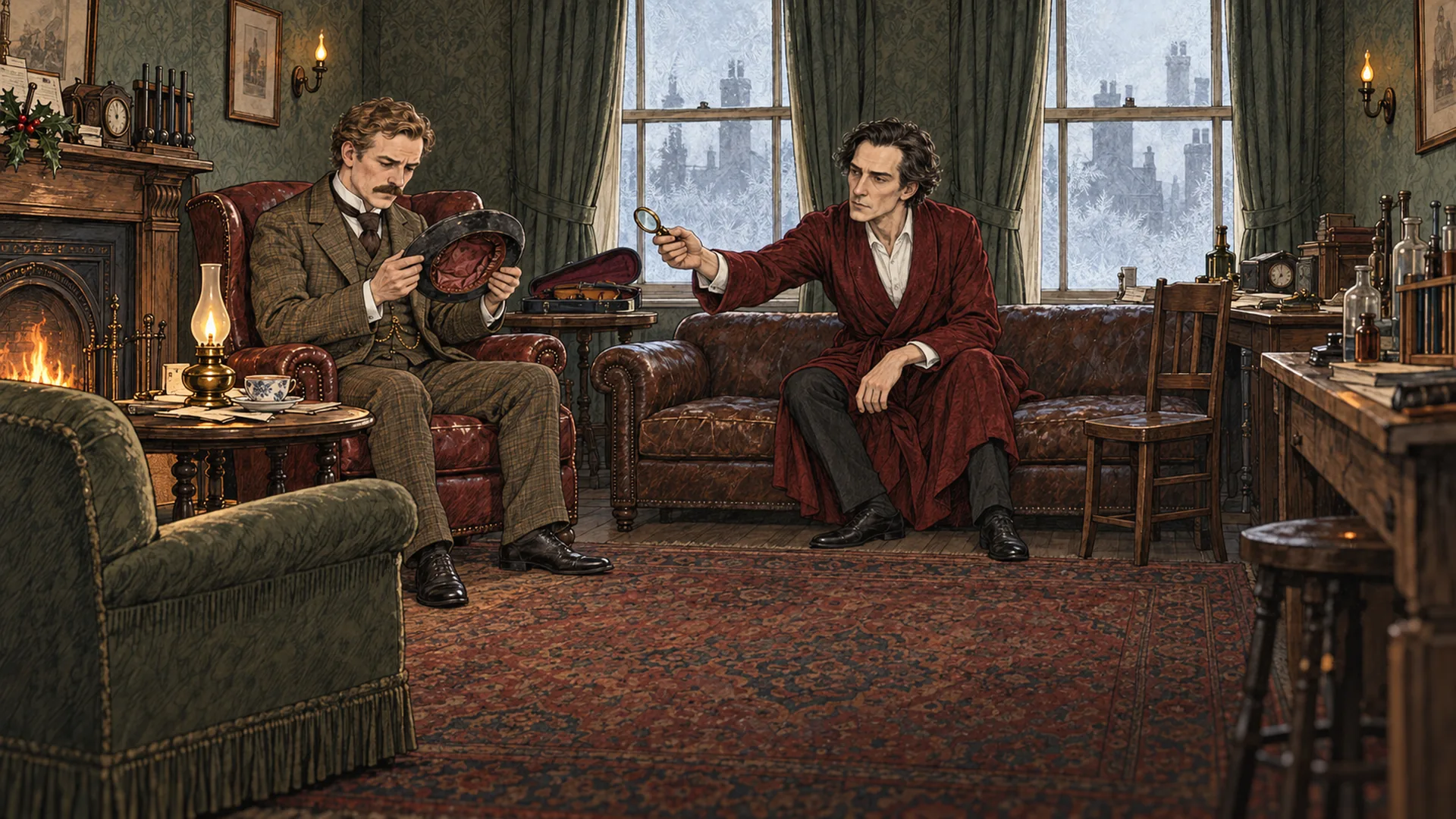
"My dear fellow, there lies the problem. It is true that 'For Mrs. Henry Baker' was printed upon a small card which was tied to the bird's left leg, and it is also true that the initials 'H. B.' are legible upon the lining of this hat, but as there are some thousands of Bakers, and some hundreds of Henry Bakers in this city of ours, it is not easy to restore lost property to any one of them."
「きみ、そこが問題なのだ。たしかに鳥の左脚には『ヘンリー・ベイカー夫人へ』と印刷した小さな札が結びつけてあったし、この帽子の裏地にも『H・B』という頭文字が読み取れる。だが、この街にはベイカーという人が何千人も、ヘンリー・ベイカーだって何百人もいるのだから、そのうちの誰かに落とし物を返すのは容易ではない」
"What, then, did Peterson do?"
「それで、ピーターソンはどうしたんだい?」
"He brought round both hat and goose to me on Christmas morning, knowing that even the smallest problems are of interest to me. The goose we retained until this morning, when there were signs that, in spite of the slight frost, it would be well that it should be eaten without unnecessary delay. Its finder has carried it off, therefore, to fulfil the ultimate destiny of a goose, while I continue to retain the hat of the unknown gentleman who lost his Christmas dinner."
「どんなに小さな問題でも私が興味を持つと知っているから、クリスマスの朝、帽子とガチョウを両方とも私のところへ持ってきたのだ。ガチョウはけさまで預かっていたが、少し冷え込んでいるとはいえ、そろそろぐずぐずせずに食べてしまったほうがよさそうな様子になってきた。そこで拾い主が持ち帰り、ガチョウとしての最後の運命を全うさせることになった。一方の私は、クリスマスのごちそうをなくした見知らぬ紳士の帽子を、いまも預かっているというわけさ」
"Did he not advertise?"
「その人は広告を出さなかったのかい?」
"No."
「出していない」
"Then, what clue could you have as to his identity?"
「じゃあ、その人の身元について、どんな手がかりがあるというんだい?」
"Only as much as we can deduce."
「推理して引き出せるものしかない」
"From his hat?"
「帽子から?」
"Precisely."
「そのとおり」