 よみうち英語Read the classics by typing
Notes Scene 8: A Question of Size
You've finished this scene
Notes on this scene
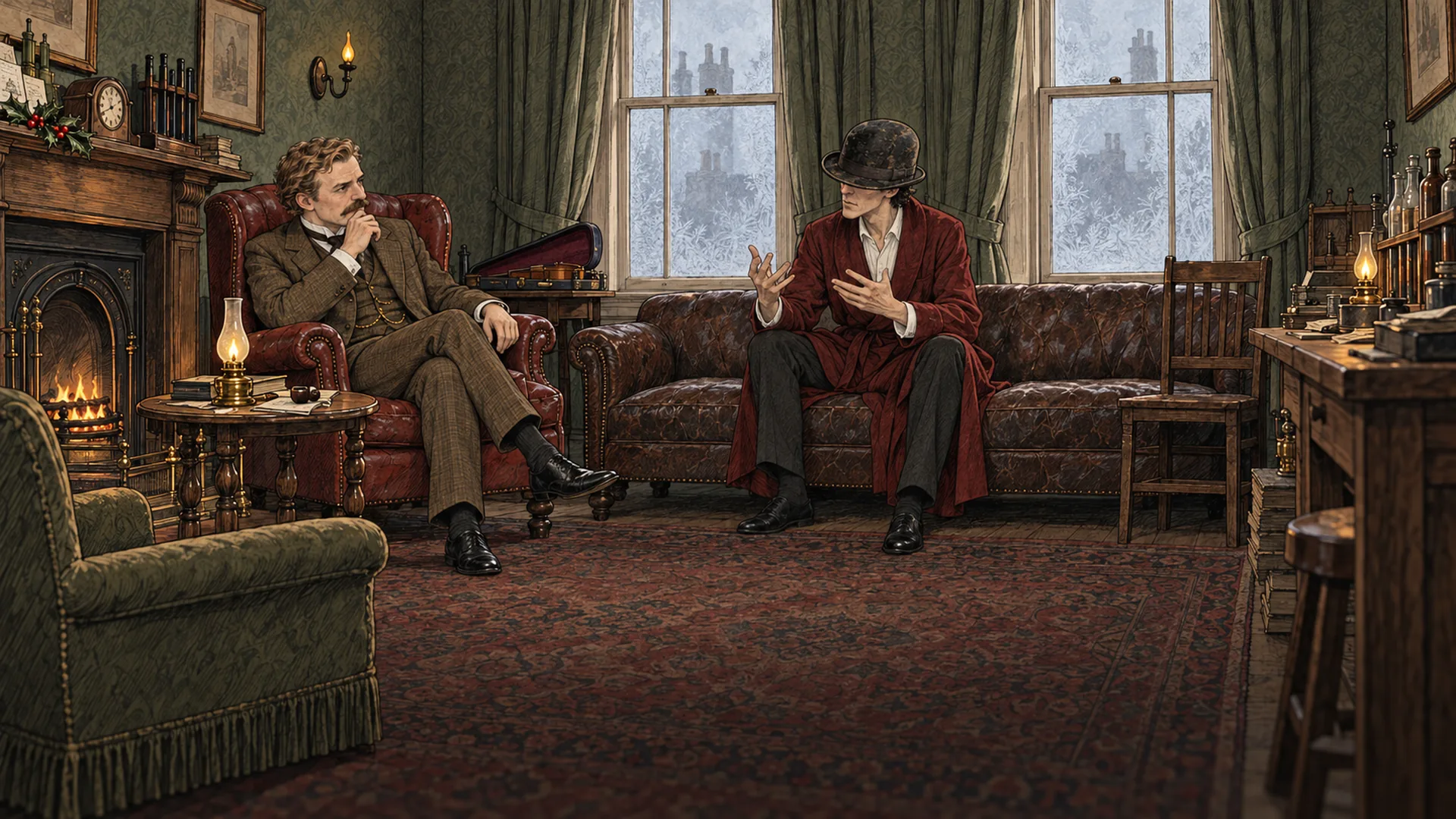
Holmes adds further details about the owner's age, habits, haircut, and home, then demonstrates his reasoning with the hat's size. The scene establishes this development clearly and closes before the next step begins, preserving the original passage's order and the limits of what the characters know at this point.
Japanese in this scene
- これほど大きな脳の持ち主なら
- In これほど大きな脳の持ち主なら, ほど sets the degree or extent expressed by the surrounding description.
- こうして結果まで教えても
- In こうして結果まで教えても, まで marks the preceding item as the endpoint or outer limit reached in this statement.
- 座ってばかりの暮らしで
- In 座ってばかりの暮らし, verb in て-form + ばかり means ‘doing nothing but’: the owner lives a life spent almost entirely sitting.
- 正直なところ
- 正直なところ is a fixed expression meaning ‘honestly’ or ‘to tell the truth.’ Watson uses it to admit that Holmes's explanation has not convinced him.
Background
- gas
- Gas was widely used for lighting Victorian streets and better-equipped homes. A house without a gas supply still depended on candles or oil lamps after dark.
Full text: original English and Japanese translation
"He has, however, retained some degree of self-respect," he continued, disregarding my remonstrance. "He is a man who leads a sedentary life, goes out little, is out of training entirely, is middle-aged, has grizzled hair which he has had cut within the last few days, and which he anoints with lime-cream. These are the more patent facts which are to be deduced from his hat. Also, by the way, that it is extremely improbable that he has gas laid on in his house."
「とはいえ、ある程度の自尊心はまだ失っていない」と、彼は私の抗議にかまわず続けた。「座ってばかりの暮らしで、めったに出歩かず、体はすっかりなまっている中年の男だ。白髪まじりの髪をここ数日のうちに刈ってもらい、ライムクリームをつけている。これらが、帽子から推理できる事実のうちの、わかりやすいほうだ。ついでに言えば、彼の家にガスが引かれている見込みはきわめて低い、ということもわかる」
"You are certainly joking, Holmes."
「冗談に決まっているよ、ホームズ」
"Not in the least. Is it possible that even now, when I give you these results, you are unable to see how they are attained?"
「冗談などであるものか。こうして結果まで教えても、まだどうやってそこへたどり着いたのか、わからないというのかね?」
"I have no doubt that I am very stupid, but I must confess that I am unable to follow you. For example, how did you deduce that this man was intellectual?"
「私がひどく鈍いのはきっとそうなんだろうが、正直なところ、きみの話についていけないよ。たとえば、この男の頭がいいことは、どうやって推理したんだい?」
For answer Holmes clapped the hat upon his head. It came right over the forehead and settled upon the bridge of his nose. "It is a question of cubic capacity," said he; "a man with so large a brain must have something in it."
答える代わりに、ホームズは帽子をぽんと自分の頭にのせた。帽子は額をすっぽりおおい、鼻すじのところで止まった。「容積の問題さ」と彼は言った。「これほど大きな脳の持ち主なら、中に何か入っているにちがいない」
"The decline of his fortunes, then?"
「じゃあ、暮らし向きが傾いたというのは?」