 よみうち英語Read the classics by typing
Notes Scene 16: Finding the Owner
You've finished this scene
Notes on this scene
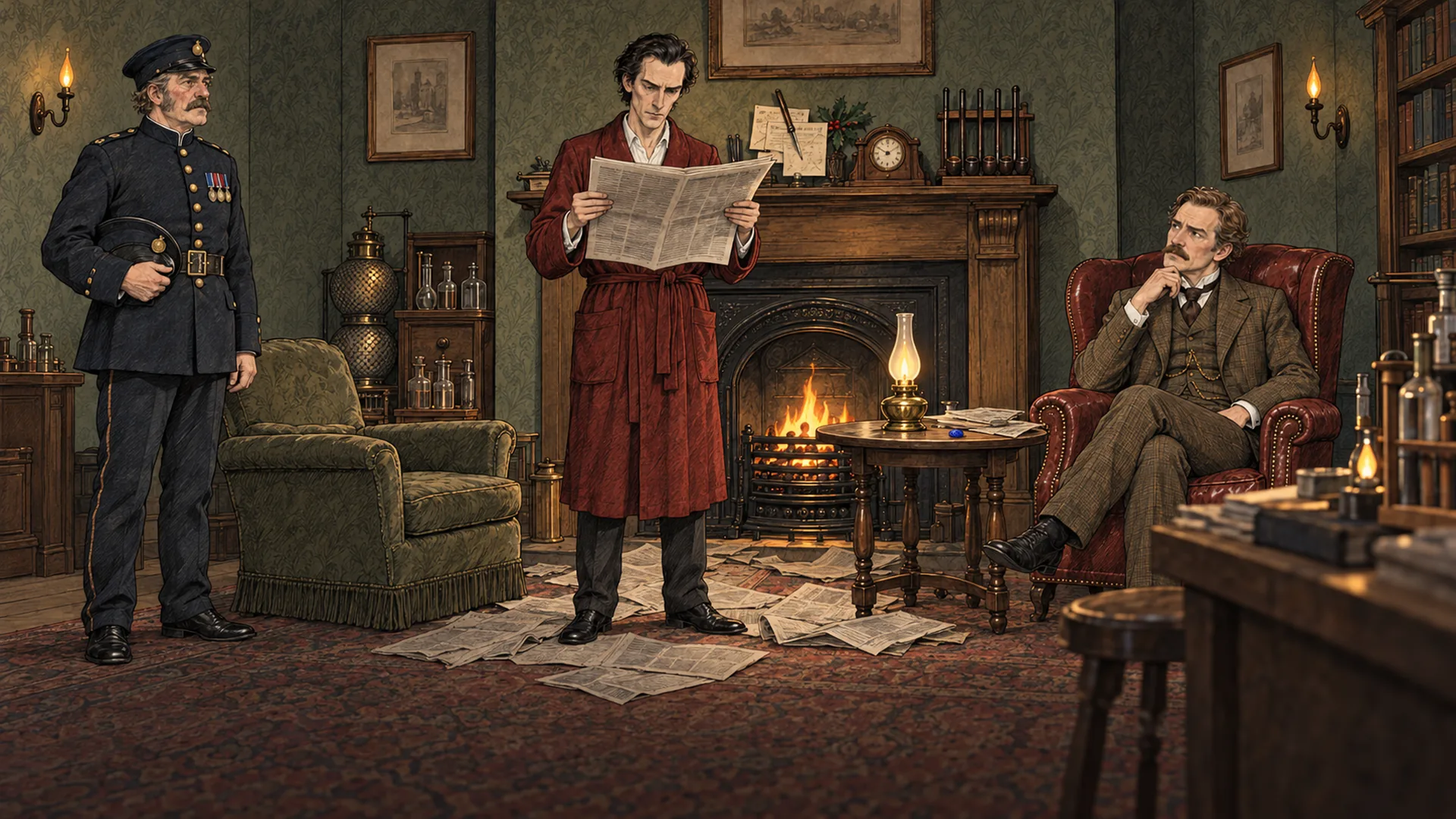
Holmes sets out to trace the missing link between the ransacked jewel case, Henry Baker, and the goose. The scene establishes this development clearly and closes before the next step begins, preserving the original passage's order and the limits of what the characters know at this point.
Japanese in this scene
- そのためには
- そのためには means ‘in order to do that.’ Holmes uses it to introduce the necessary first step in tracing the stone.
- 警察裁判所の話はここまでだ
- In 警察裁判所の話はここまでだ, まで marks the preceding item as the endpoint or outer limit reached in this statement.
- このちょっとした謎で彼がどんな役を演じたのかを確かめなければならない
- In このちょっとした謎で彼がどんな役を演じたのかを確かめなければならない, ちょっとした modifies the following noun as small but noteworthy rather than completely trivial.
- でない
- Here でない is the plain negative form of である, meaning that the statement before it ‘is not’ the case.
Background
- police-court
- A police court handled minor offences and preliminary hearings, deciding whether a serious case should proceed to a higher criminal court.
Full text: original English and Japanese translation
"Hum! So much for the police-court," said Holmes thoughtfully, tossing aside the paper. "The question for us now to solve is the sequence of events leading from a rifled jewel-case at one end to the crop of a goose in Tottenham Court Road at the other. You see, Watson, our little deductions have suddenly assumed a much more important and less innocent aspect. Here is the stone; the stone came from the goose, and the goose came from Mr. Henry Baker, the gentleman with the bad hat and all the other characteristics with which I have bored you. So now we must set ourselves very seriously to finding this gentleman and ascertaining what part he has played in this little mystery. To do this, we must try the simplest means first, and these lie undoubtedly in an advertisement in all the evening papers. If this fail, I shall have recourse to other methods."
「ふむ!警察裁判所の話はここまでだ」とホームズは考え込むように言い、新聞を脇へ放り出した。「いま私たちが解くべき問題は、一方の端にある荒らされた宝石箱から、もう一方の端にあるトテナム・コート・ロードのガチョウの餌袋へとつながる、出来事の連なりだ。いいかね、ワトソン、私たちのささやかな推理が、急にずっと重大で、ずっと穏やかでない様相を帯びてきたのだ。ここに石がある。この石はガチョウから出てきて、そのガチョウは、あのひどい帽子の持ち主で、ほかにもきみを退屈させたさまざまな特徴を持つ紳士、ヘンリー・ベイカー氏から来たのだ。だから今度は、本腰を入れてこの紳士を見つけ出し、このちょっとした謎で彼がどんな役を演じたのかを確かめなければならない。そのためには、まずいちばん簡単な手から試すべきで、それは間違いなく、夕刊のすべてに広告を出すことだ。それでうまくいかなければ、ほかの方法に頼るとしよう」
"What will you say?"
「広告には何と書くんだい?」