 よみうち英語Read the classics by typing
Notes Scene 2: Drifted Apart
You've finished this scene
Notes on this scene
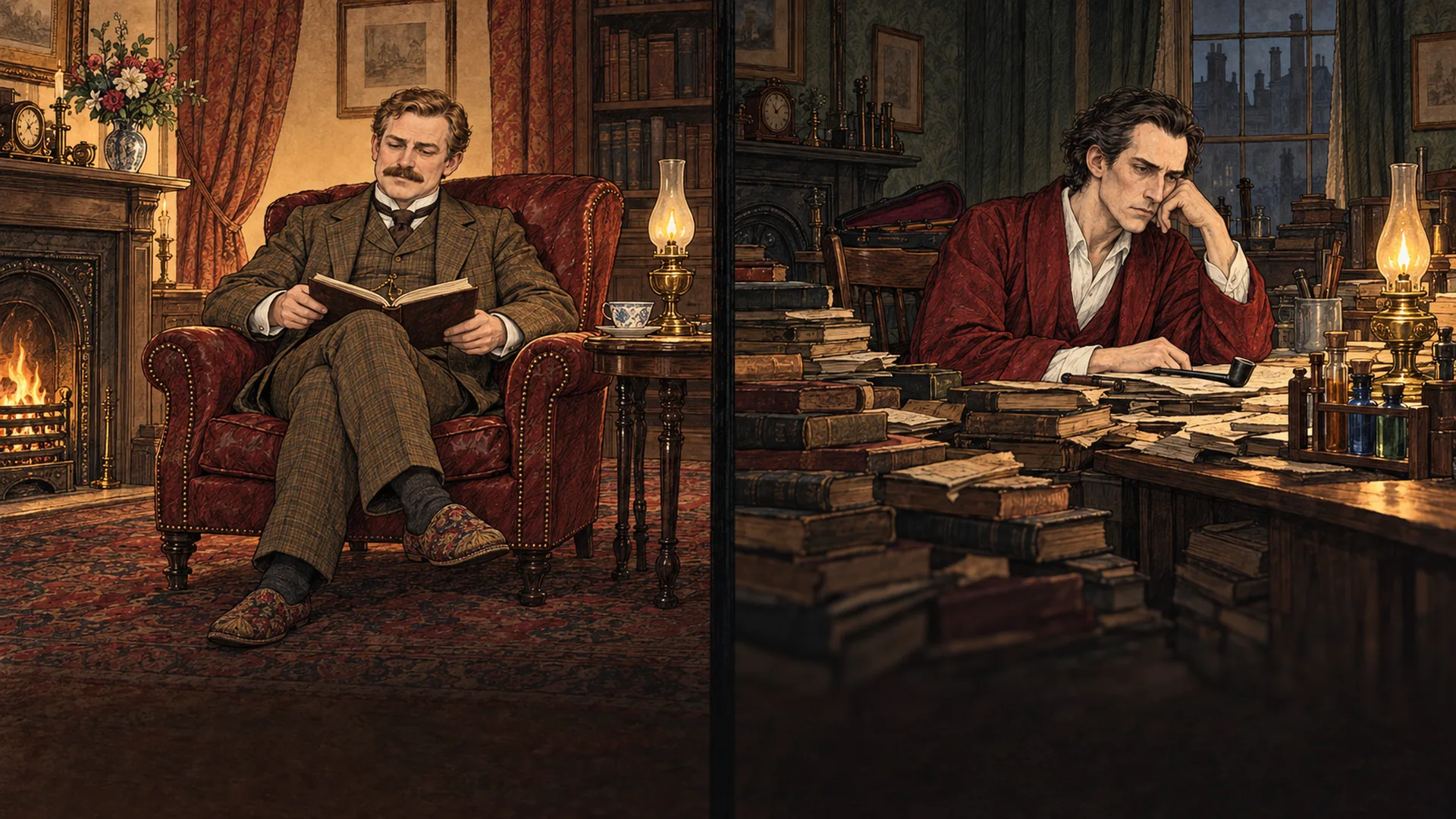
Watson explains why he has seen little of Holmes since marrying. Domestic happiness occupies Watson, while Holmes stays at Baker Street, alternating between drug-induced inactivity and intense detective work. Watson hears occasional reports of remarkable cases, but knows little about his former companion's everyday life beyond what newspaper readers can learn.
Japanese in this scene
- 会っていなかった
- The ている form describes an ongoing situation; its past negative, ていなかった, says that this situation had not been occurring. With このところ, Watson means he had seen little of Holmes lately. The dictionary form of 会って is 会う, “to meet.”
- 心を奪われていた
- Literally “his heart had been stolen,” this passive expression means being captivated or absorbed. Watson is absorbed in his new domestic life. を marks 心 as the affected part, while the surrounding sentence explains what occupies his attention.
- 見込みなしとして
- 見込みなし means “no prospect” or “hopeless.” として presents the judgement under which something is treated: the police discarded the clues as hopeless. This use differs from a role such as 医師として, “as a doctor.”
- 誰でも
- A question word followed by でも can express unrestricted choice. 誰でも means “anyone,” rather than asking who. Here the relative clause describes information any newspaper reader would know; it contrasts with Watson’s lack of personal news.
Background
- Cocaine
- In late nineteenth-century Britain, cocaine was a drug legally available from pharmacies. Its harmful effects became widely known somewhat later, so contemporary readers would not have found Holmes’s use of it against boredom quite as strange as readers might today.
- The daily press
- Daily newspapers reached a broad public in the late Victorian period. Watson learning of his friend’s activities through newspapers shows that Holmes is already a figure known to the public.
Full text: original English and Japanese translation
I had seen little of Holmes lately. My marriage had drifted us away from each other. My own complete happiness, and the home-centred interests which rise up around the man who first finds himself master of his own establishment, were sufficient to absorb all my attention, while Holmes, who loathed every form of society with his whole Bohemian soul, remained in our lodgings in Baker Street, buried among his old books, and alternating from week to week between cocaine and ambition, the drowsiness of the drug, and the fierce energy of his own keen nature. He was still, as ever, deeply attracted by the study of crime, and occupied his immense faculties and extraordinary powers of observation in following out those clues, and clearing up those mysteries which had been abandoned as hopeless by the official police. From time to time I heard some vague account of his doings: of his summons to Odessa in the case of the Trepoff murder, of his clearing up of the singular tragedy of the Atkinson brothers at Trincomalee, and finally of the mission which he had accomplished so delicately and successfully for the reigning family of Holland. Beyond these signs of his activity, however, which I merely shared with all the readers of the daily press, I knew little of my former friend and companion.
このところ、私はホームズとほとんど会っていなかった。私の結婚が、二人を互いに遠ざけていたのだ。私のほうは、満ち足りた幸せと、初めて一家の主となった男のまわりに湧き起こる家庭の関心事とで、すっかり心を奪われていた。一方ホームズは、ボヘミアンの魂のすべてで人付き合いというものを嫌い、ベイカー街の二人の下宿に残って古い本に埋もれていた。そして週ごとに、コカインと野心のあいだ、つまり薬のまどろみと、鋭い気性からくる激しい活力のあいだを行き来していた。彼は相変わらず犯罪の研究に深く惹かれていた。そして並外れた才能と驚くべき観察力を、警察が見込みなしとして投げ出した手がかりを追い、謎を解き明かすことに注いでいた。ときおり、彼の活躍についてぼんやりした話が耳に入った。トレポフ殺人事件でオデッサに呼ばれたこと、トリンコマリーでのアトキンソン兄弟の奇妙な悲劇を解決したこと、そして最後に、オランダ王家のために実に繊細かつ見事に果たした任務のことなどだ。だが、新聞の読者なら誰でも知っているこうした活動の気配のほかには、かつての友であり相棒である彼について、私はほとんど何も知らなかった。