 よみうち英語Read the classics by typing
Notes Scene 3: The Window in Baker Street
You've finished this scene
Notes on this scene
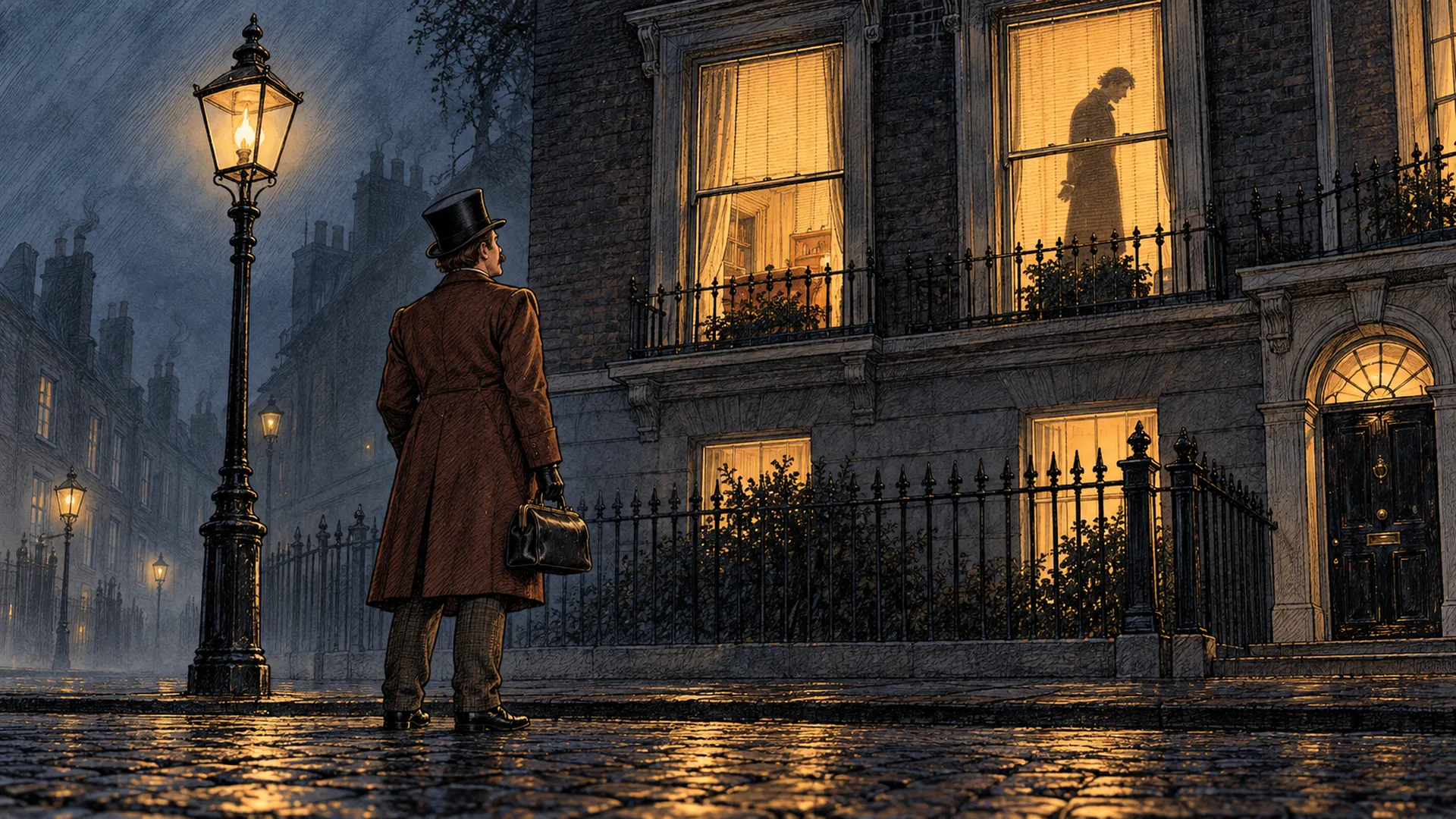
Passing Baker Street after visiting a patient, Watson feels a strong wish to see Holmes again. Through the lit window he recognizes Holmes’s restless silhouette. Knowing his friend’s habits, Watson understands that Holmes is absorbed in a new investigation. He rings the bell and is shown up to the room they once shared.
Japanese in this scene
- 道すがら
- Attached to a word such as 道, すがら means “along the way” or “while going.” 道すがら places Watson’s encounter during his journey, rather than making Baker Street the purpose of his trip. It is more literary than 途中で.
- 思いに駆られた
- The passive of 駆る, “to drive,” expresses being moved by a strong feeling. The pattern 気持ち・思い + に駆られる identifies the feeling that drives a person. Here Watson feels a powerful wish to see his friend again.
- 行ったり来たりしていた
- Verb た-form + り presents actions as examples or repeated alternatives. 行ったり来たりする combines going and coming to mean moving back and forth. The final ていた puts the repeated movement in an ongoing past scene.
- 案内された
- 案内する means “to guide” or “to show someone somewhere.” The passive 案内された makes Watson the person being shown in. Japanese can leave the person doing the guiding unstated when that person is not the focus.
Background
- A Study in Scarlet
- A Study in Scarlet is the first case, in which Holmes and Watson meet and begin living together. “My wooing” is generally understood to refer to the preceding story in which Watson met his wife. Baker Street is therefore a place full of memories for Watson.
- A shadow behind the blinds
- A figure in a room brightly lit by gas appears from outside as a dark silhouette against the blinds. It is a scene characteristic of Victorian London with its street lighting and gas lamps. Watson reads his friend’s state from the movement of the shadow alone.
Full text: original English and Japanese translation
One night—it was on the twentieth of March, 1888—I was returning from a journey to a patient (for I had now returned to civil practice), when my way led me through Baker Street. As I passed the well-remembered door, which must always be associated in my mind with my wooing, and with the dark incidents of the Study in Scarlet, I was seized with a keen desire to see Holmes again, and to know how he was employing his extraordinary powers. His rooms were brilliantly lit, and, even as I looked up, I saw his tall, spare figure pass twice in a dark silhouette against the blind. He was pacing the room swiftly, eagerly, with his head sunk upon his chest and his hands clasped behind him. To me, who knew his every mood and habit, his attitude and manner told their own story. He was at work again. He had risen out of his drug-created dreams and was hot upon the scent of some new problem. I rang the bell and was shown up to the chamber which had formerly been in part my own.
ある晩のこと、それは1888年3月20日だったが、私は患者のもとからの帰り道にあった(私はこのころ、また町医者に戻っていたのだ)。その道すがら、ベイカー街を通りかかった。見覚えのあるあの扉は、私の心の中でいつまでも、妻への求婚と『緋色の研究』の暗い事件とに結びついている。その前を通ったとき、ホームズにもう一度会いたい、彼があの並外れた力を今どう使っているのか知りたい、という強い思いに駆られた。彼の部屋には明々と灯がともっていた。見上げたちょうどそのとき、背が高く痩せた彼の姿が、ブラインドに黒い影となって二度横切るのが見えた。彼は頭を胸に垂れ、両手を後ろで組んで、すばやく、熱心に部屋の中を行ったり来たりしていた。彼の気分も癖も知り尽くしている私には、その姿勢と様子がすべてを物語っていた。彼はまた仕事に取りかかっているのだ。薬が生んだ夢から抜け出し、何か新しい問題の匂いを夢中で追っているのだ。私は呼び鈴を鳴らし、かつては半分私の部屋でもあった部屋へと案内された。