 よみうち英語Read the classics by typing
Notes Scene 4: Reunion
You've finished this scene
Notes on this scene
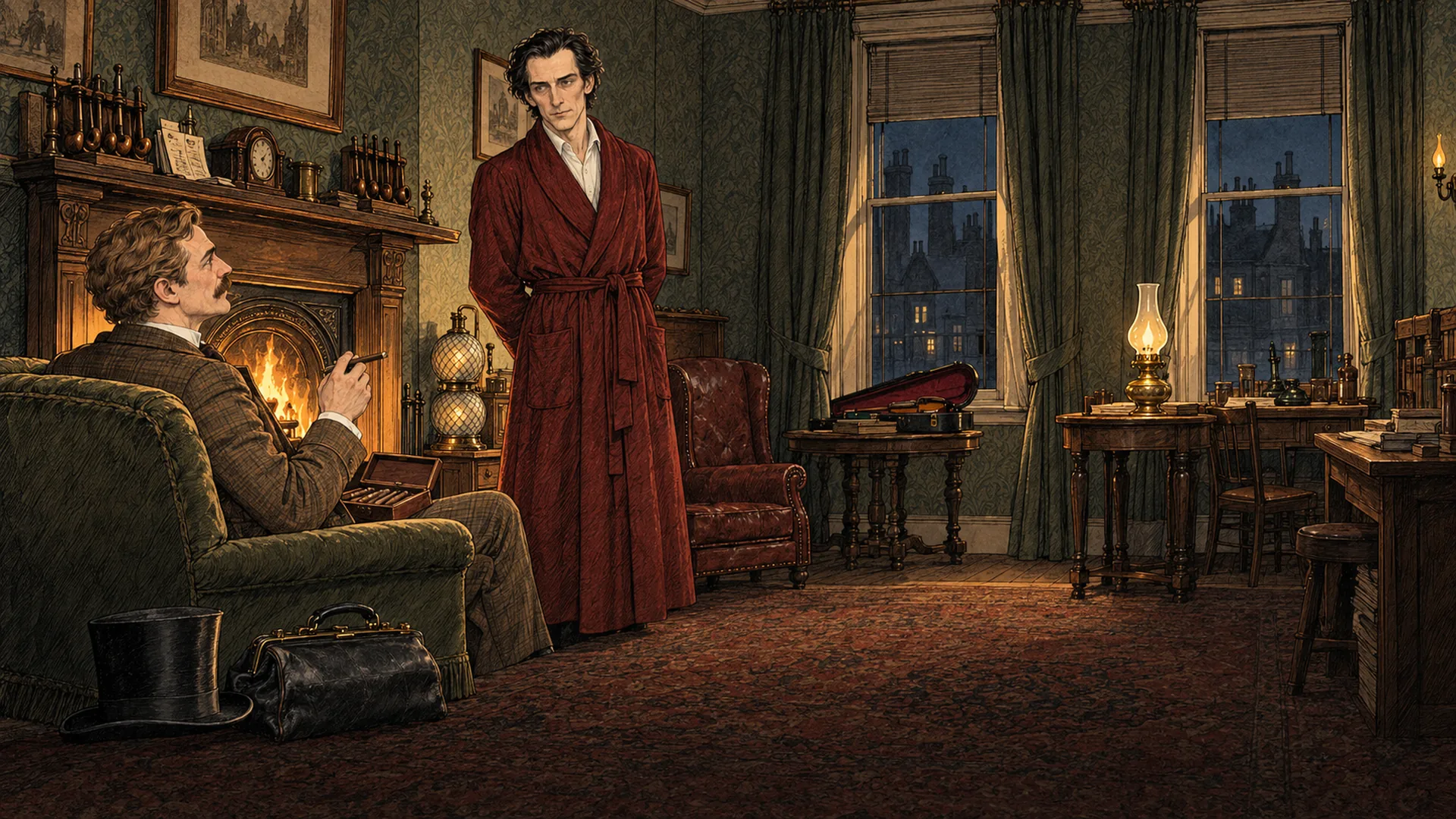
Holmes welcomes Watson in his understated way, offering him a chair and refreshments. After looking him over, he comments on Watson’s married life, estimates his weight gain, and recognizes that he has returned to medical practice. Watson corrects the weight estimate but is puzzled by his friend’s knowledge of his work.
Japanese in this scene
- 大げさだったためしはほとんどない
- A past verb or description followed by ためしがない says there has been no instance of it. Here は marks the instance as a topic, and ほとんど softens the negative: Holmes has hardly ever been demonstrative. It describes a familiar pattern, rather than one isolated welcome.
- 性に合っている
- 性 is read しょう in this expression. 性に合う means that something suits a person’s temperament. The ている form describes the resulting state: married life agrees with Watson. Reading 性 as せい would miss the established expression.
- 七ポンド半
- 半 placed after a unit adds half a unit. 七ポンド半 therefore means seven and a half pounds. Watson’s reply 七ポンド removes that extra half. Numbers written in kanji here receive readings, whereas Arabic numerals in the text are typed as written.
- つもりだなんて
- つもりだ describes an intention. なんて picks up the preceding statement in an informal way, here with a sense of surprise: Holmes had not heard that Watson intended to return to work. The sentence concerns Watson’s intention, not Holmes’s own.
Background
- Gasogene
- A gasogene was a household device for making carbonated water, shaped like two connected glass globes. It stood beside a case of spirits; offering a visitor whisky or another spirit diluted with soda water was part of a gentleman’s hospitality at the time.
Full text: original English and Japanese translation
His manner was not effusive. It seldom was; but he was glad, I think, to see me. With hardly a word spoken, but with a kindly eye, he waved me to an armchair, threw across his case of cigars, and indicated a spirit case and a gasogene in the corner. Then he stood before the fire and looked me over in his singular introspective fashion.
彼の態度は大げさではなかった。大げさだったためしはほとんどない。それでも、私に会えて喜んでいたと思う。言葉はほとんど交わさなかったが、やさしい目つきで、彼は私に肘掛け椅子をすすめ、葉巻の箱を放ってよこし、部屋の隅の酒瓶台とソーダ水製造器を指し示した。それから暖炉の前に立ち、彼独特の考え込むようなやり方で、私をじっくりと眺めた。
"Wedlock suits you," he remarked. "I think, Watson, that you have put on seven and a half pounds since I saw you."
「結婚生活が性に合っているようだね」と彼は言った。「ワトソン、この前会ったときから七ポンド半は太ったんじゃないかな」
"Seven!" I answered.
「七ポンドだよ」と私は答えた。
"Indeed, I should have thought a little more. Just a trifle more, I fancy, Watson. And in practice again, I observe. You did not tell me that you intended to go into harness."
「そうかい。もう少し多いと思ったけれどね。ほんのちょっとだけ多いと思うよ、ワトソン。それに、また開業しているようだね。仕事に戻るつもりだなんて、聞いていなかったよ」
"Then, how do you know?"
「じゃあ、どうして分かるんだい」