 よみうち英語Read the classics by typing
Notes Scene 9: A Mysterious Note
You've finished this scene
Notes on this scene
The anonymous writer announces a visit by a gentleman who may be masked, stressing Holmes’s discretion in a recent royal matter. Watson finds the message puzzling. Holmes warns against forming theories before examining the evidence. He asks what can be learned from the letter itself, and Watson studies its handwriting and paper.
Japanese in this scene
- ご相談したい
- ご adds a respectful or formal tone to 相談, while したい expresses a wish to consult. The surrounding とのことです reports what the expected visitor wishes, rather than making this a direct statement of Holmes’s intention.
- なさったお働き
- なさる is the respectful equivalent of する; なさった is its past form. The prefix お adds respect to 働き as well. The letter treats Holmes as a respected professional, contrasting with the familiar plain speech between Holmes and Watson.
- ないうちに
- A negative verb or description followed by うちに means before that situation changes or before something has happened. Here it means while there is still no evidence. Holmes criticizes the timing of forming a theory, not just a particular mistaken theory.
- 知らず知らずのうちに
- The repeated negative form 知らず知らず has become an expression meaning unawares or without realizing it. Combined with のうちに, it describes a process happening before the person notices. Holmes warns that a prior theory can unconsciously distort the facts.
Background
- “A quarter to eight”
- “A quarter to eight” means a quarter of an hour before eight, or 7:45. “A quarter past eight” would mean 8:15. Expressing times with “quarter,” meaning fifteen minutes, remains common in English.
Full text: original English and Japanese translation
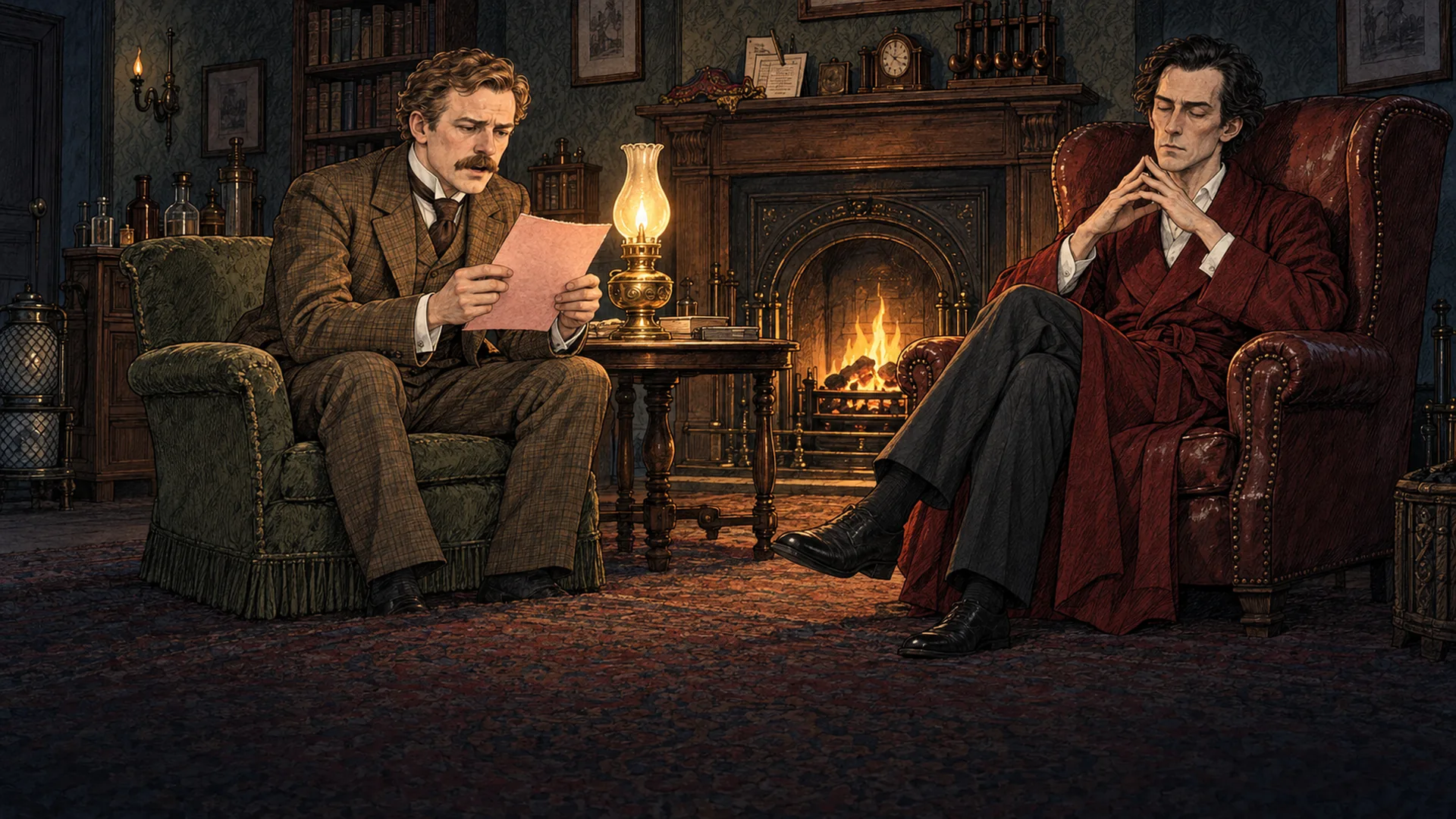
"There will call upon you to-night, at a quarter to eight o'clock," it said, "a gentleman who desires to consult you upon a matter of the very deepest moment. Your recent services to one of the royal houses of Europe have shown that you are one who may safely be trusted with matters which are of an importance which can hardly be exaggerated. This account of you we have from all quarters received. Be in your chamber then at that hour, and do not take it amiss if your visitor wear a mask."
「今夜八時十五分前、ある紳士があなたのもとを訪れます」と手紙にはあった。「このうえなく重大な件で、ご相談したいとのことです。先ごろヨーロッパのある王家のためになさったお働きから、あなたが、どれほど言っても言い過ぎにならないほど重要な事柄を、安心して任せられる方だと分かっております。あなたについてのこの評判を、私どもはあらゆる方面から受け取っております。その時刻にはお部屋にいてください。また、訪問者が仮面をつけていても、気を悪くなさらないように」
"This is indeed a mystery," I remarked. "What do you imagine that it means?"
「これはまったく謎だね」と私は言った。「どういうことだと思うかい」
"I have no data yet. It is a capital mistake to theorise before one has data. Insensibly one begins to twist facts to suit theories, instead of theories to suit facts. But the note itself. What do you deduce from it?"
「まだ材料がない。材料もないうちに理屈を組み立てるのは、大きな間違いだよ。知らず知らずのうちに、事実に合わせて理屈を立てるのではなく、理屈に合わせて事実をねじ曲げはじめてしまうからね。だが、手紙そのものはどうだ。そこから何が推理できるかね」
I carefully examined the writing, and the paper upon which it was written.
私は筆跡と、それが書かれた紙とを、念入りに調べた。