 よみうち英語Read the classics by typing
Notes Scene 10: The Watermark
You've finished this scene
Notes on this scene
Watson judges the writer to be wealthy because the notepaper is expensive and unusually strong. Holmes focuses on its unusual character and says it is not English paper. At his suggestion, Watson holds it against the light and finds letters woven into it. Watson guesses they identify the manufacturer.
Japanese in this scene
- まねようとしながら
- The volitional form まねよう followed by とする means trying to imitate. ながら links that attempt to speaking: Watson voices his guess while trying to follow his friend’s method. It does not mean that Holmes is the one imitating Watson.
- 買えない
- 買える is the potential form of 買う, “to buy.” Its negative 買えない means “cannot buy.” Watson is estimating the minimum price of this quality of paper, not saying that he personally has no money to buy it.
- かざしてごらん
- Verb て-form + ごらん is a familiar invitation to try an action and see the result. It is related to the respectful verb ご覧になる, but this request is informal. Holmes asks Watson to hold the paper up to the light.
- いや、むしろ
- いや can introduce a correction to one’s own statement, rather than simply rejecting another person’s opinion. むしろ offers the alternative that fits better. Watson revises “the manufacturer’s name” to “a combination of the manufacturer’s initials.”
Background
- Half a crown
- A crown was a British coin denomination worth five shillings, so half a crown was two shillings and sixpence. With twenty shillings to the pound, that was one eighth of a pound: a rather luxurious price for a packet of notepaper.
- Watermarks
- A watermark is a pattern or lettering formed by varying paper thickness during manufacture. It appears when held to the light. Fine paper often carried a manufacturer’s name or mark, providing a clue to its origin.
Full text: original English and Japanese translation
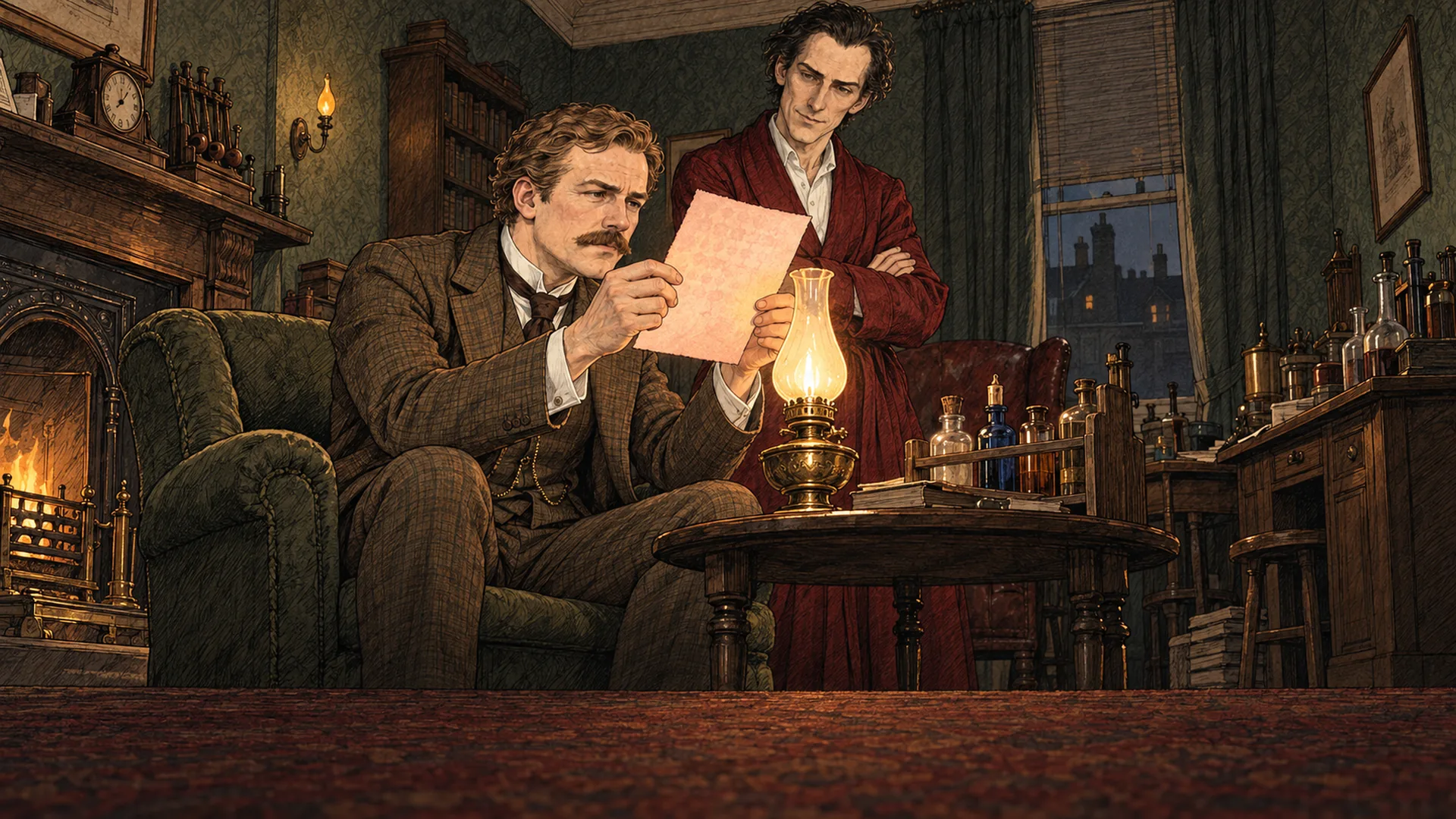
"The man who wrote it was presumably well to do," I remarked, endeavouring to imitate my companion's processes. "Such paper could not be bought under half a crown a packet. It is peculiarly strong and stiff."
「これを書いた男は、たぶん裕福なんだろう」と私は、友人のやり方をまねようとしながら言った。「こんな紙は、一包み半クラウン以下では買えないよ。妙に丈夫で、張りがある」
"Peculiar—that is the very word," said Holmes. "It is not an English paper at all. Hold it up to the light."
「妙に、か。まさにその言葉だよ」とホームズは言った。「これはイギリスの紙などではないんだ。明かりにかざしてごらん」
I did so, and saw a large "E" with a small "g," a "P," and a large "G" with a small "t" woven into the texture of the paper.
そうしてみると、紙の地に、大きな「E」と小さな「g」、「P」、それに大きな「G」と小さな「t」が織り込まれているのが見えた。
"What do you make of that?" asked Holmes.
「これをどう見るかね」とホームズが尋ねた。
"The name of the maker, no doubt; or his monogram, rather."
「製造元の名前だろうね。いや、むしろその頭文字の組み合わせかな」