 よみうち英語Read the classics by typing
Notes Scene 11: The Gazetteer
You've finished this scene
Notes on this scene
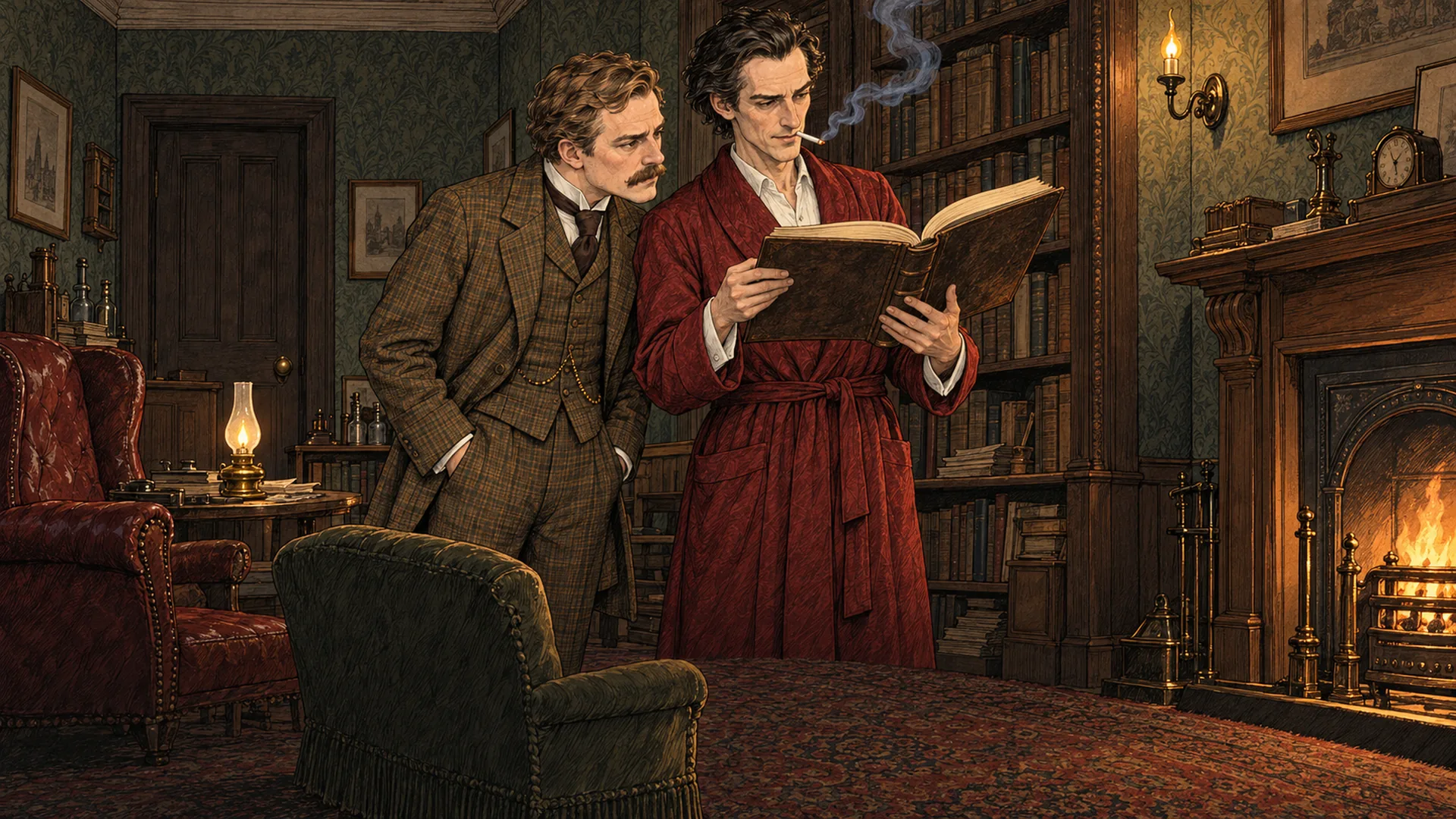
Holmes explains the watermark’s abbreviated German words for company and paper, then looks up the remaining letters in a gazetteer. He finds Egria in Bohemia, near Carlsbad, noted for glass and paper factories. Delighted by the discovery, he turns to Watson, who concludes that the paper was made in Bohemia.
Japanese in this scene
- 小さな
- 小さな comes directly before a noun, as in 小さな文字, “small letters.” Unlike 小さい, it is not normally used by itself as a predicate. Holmes contrasts the sizes of the letters to explain how the abbreviation is written.
- 残るは
- 残るは is a compact, slightly literary way to introduce what remains. The remaining item is brought into focus after other items have been explained. Here Holmes has dealt with the other letters and turns to Eg.
- のぞいてみよう
- Verb て-form + みる means to try doing something and see what is found. The volitional みよう proposes that action: “let us take a look.” It differs from the ordinary visual meaning of 見る, although the action here also involves looking.
- によって知られる
- によって can identify the basis for a reputation, while 知られる is the passive of 知る: “to be known.” The gazetteer describes the features for which the place is known. This によって does not introduce a person who performs an action.
Background
- Bohemia
- Bohemia corresponds to the western part of present-day Czechia. At the time it belonged to Austria-Hungary and had many German speakers. Carlsbad, now Karlovy Vary, was known among Europe’s upper classes as a spa town.
- Wallenstein
- Wallenstein commanded imperial forces during the Thirty Years’ War and was assassinated in 1634 at Eger in Bohemia, now Cheb. The story’s name “Egria” is thought to be based on that town.
Full text: original English and Japanese translation
"Not at all. The 'G' with the small 't' stands for 'Gesellschaft,' which is the German for 'Company.' It is a customary contraction like our 'Co.' 'P,' of course, stands for 'Papier.' Now for the 'Eg.' Let us glance at our Continental Gazetteer." He took down a heavy brown volume from his shelves. "Eglow, Eglonitz—here we are, Egria. It is in a German-speaking country—in Bohemia, not far from Carlsbad. 'Remarkable as being the scene of the death of Wallenstein, and for its numerous glass-factories and paper-mills.' Ha, ha, my boy, what do you make of that?" His eyes sparkled, and he sent up a great blue triumphant cloud from his cigarette.
「まるで違うよ。小さな『t』のついた『G』は『ゲゼルシャフト』の略で、ドイツ語で『会社』という意味だ。英語の『Co.』と同じ、よくある略し方だよ。『P』はもちろん、『パピーア』、つまり紙のことだ。さて、残るは『Eg』だ。大陸地名辞典をのぞいてみよう」彼は棚から、ずっしりした茶色の本を一冊取り出した。「エグロー、エグロニッツ、と……あった、エグリアだ。ドイツ語を話す国、ボヘミアにあって、カールスバートからそう遠くない。『ヴァレンシュタインが死んだ地として、また数多くのガラス工場と製紙工場によって知られる』ははあ、どうだい、きみ、これをどう見るかね」彼は目を輝かせ、勝ち誇ったように紙巻きたばこの青い煙を大きく吹き上げた。
"The paper was made in Bohemia," I said.
「その紙はボヘミアで作られたんだね」と私は言った。