 よみうち英語Read the classics by typing
Notes Scene 44: A Conversation After Lunch
You've finished this scene
Notes on this scene
Holmes appears troubled and asks Watson's advice about what he should do. He then revisits two details that struck them both: the call before the father saw his son, and the dying reference to a rat. Although Watson and Holmes interpreted them differently, Holmes proposes to proceed by assuming James's account is entirely true.
Japanese in this scene
- 決めかねている
- A verb stem followed by かねる means to find it difficult to do something or be unable to bring oneself to do it. Holmes has not settled how to act, despite his investigative confidence.
- 説明させてくれ
- The causative させて followed by くれ asks permission: ‘let me explain.’ Between friends, this direct form is natural. It does not order Watson to make another person explain.
- 本当だと仮定することにしよう
- と marks the proposition being assumed. 〜ことにしよう proposes a working decision: let us take his account as true for the investigation, without claiming that the assumption is already proved.
Full text: original English and Japanese translation
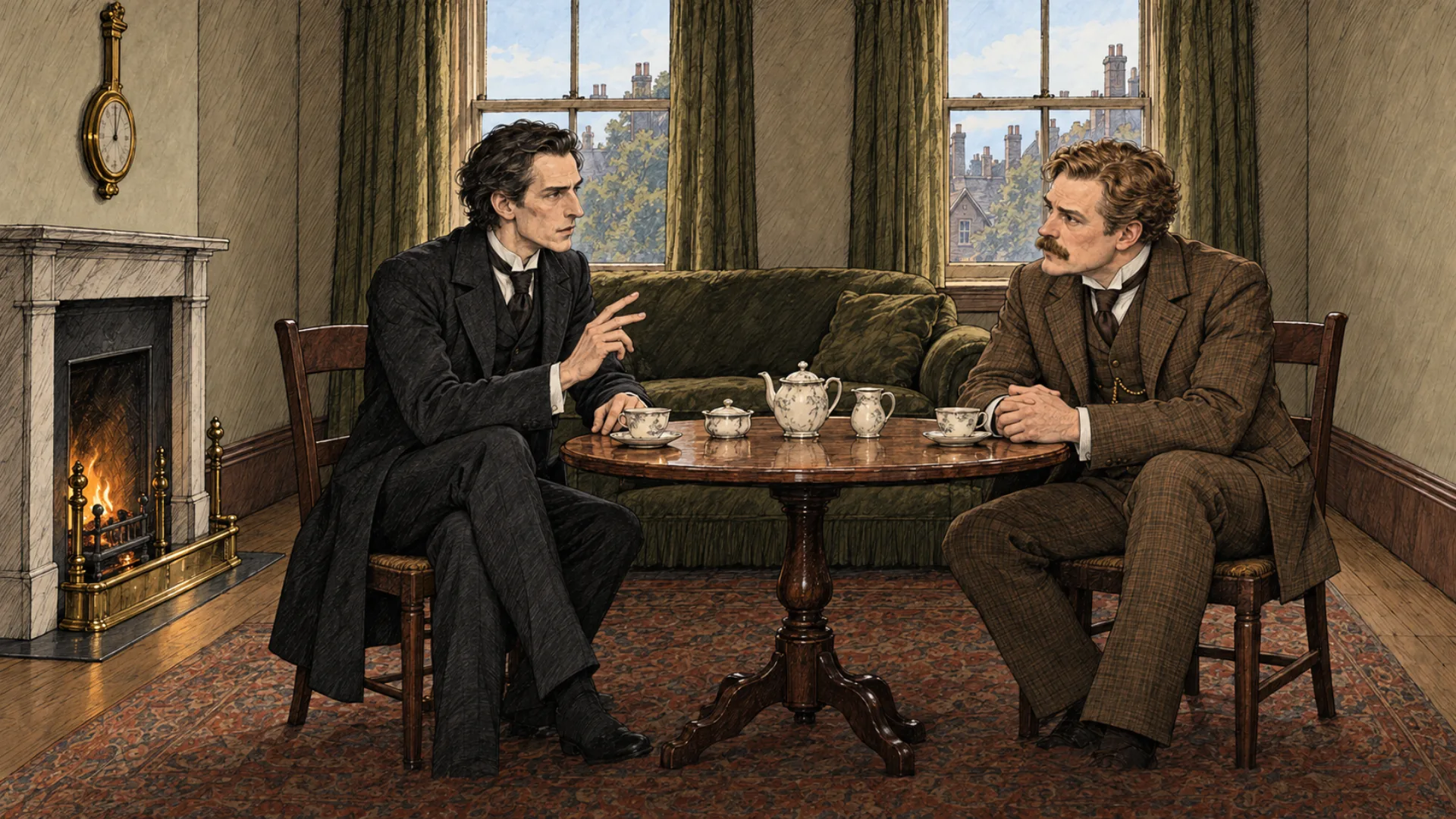
Having left Lestrade at his rooms, we drove to our hotel, where we found lunch upon the table. Holmes was silent and buried in thought with a pained expression upon his face, as one who finds himself in a perplexing position.
レストレードを下宿で降ろしたあと、私たちは馬車で自分たちの宿へ向かった。そこでは、テーブルに昼食が用意されていた。ホームズは黙って考え込み、困った立場に置かれた人のように、苦しげな表情を浮かべていた。
"Look here, Watson," he said when the cloth was cleared "just sit down in this chair and let me preach to you for a little. I don't know quite what to do, and I should value your advice. Light a cigar and let me expound."
「いいかい、ワトソン」と食卓が片づくと彼は言った。「ちょっとこの椅子に座って、少しばかり私の話を聞いてくれ。どうすればよいのか、どうも決めかねている。きみの助言をもらえればありがたい。葉巻に火をつけて、説明させてくれ」
"Pray do so."
「どうぞ、聞かせてくれ」
"Well, now, in considering this case there are two points about young McCarthy's narrative which struck us both instantly, although they impressed me in his favour and you against him. One was the fact that his father should, according to his account, cry 'Cooee!' before seeing him. The other was his singular dying reference to a rat. He mumbled several words, you understand, but that was all that caught the son's ear. Now from this double point our research must commence, and we will begin it by presuming that what the lad says is absolutely true."
「さて、この事件を考えるうえで、若いマッカーシーの話には、私たち二人ともすぐに心を引かれた点が二つあったね。ただし、私は彼に有利、きみは不利な点と受け取った。一つは、彼の説明によれば、父親が息子を見る前に『クーイー』と叫んだという事実だ。もう一つは、死に際の、ネズミについての奇妙な言葉だ。父親はいくつか言葉をつぶやいたが、息子に聞き取れたのはそれだけだったのだね。そこで、この二点から調査を始めなければならない。まずは青年の言うことがまったく本当だと仮定することにしよう」