 よみうち英語Read the classics by typing
Notes Scene 7: Why She Came
You've finished this scene
Notes on this scene
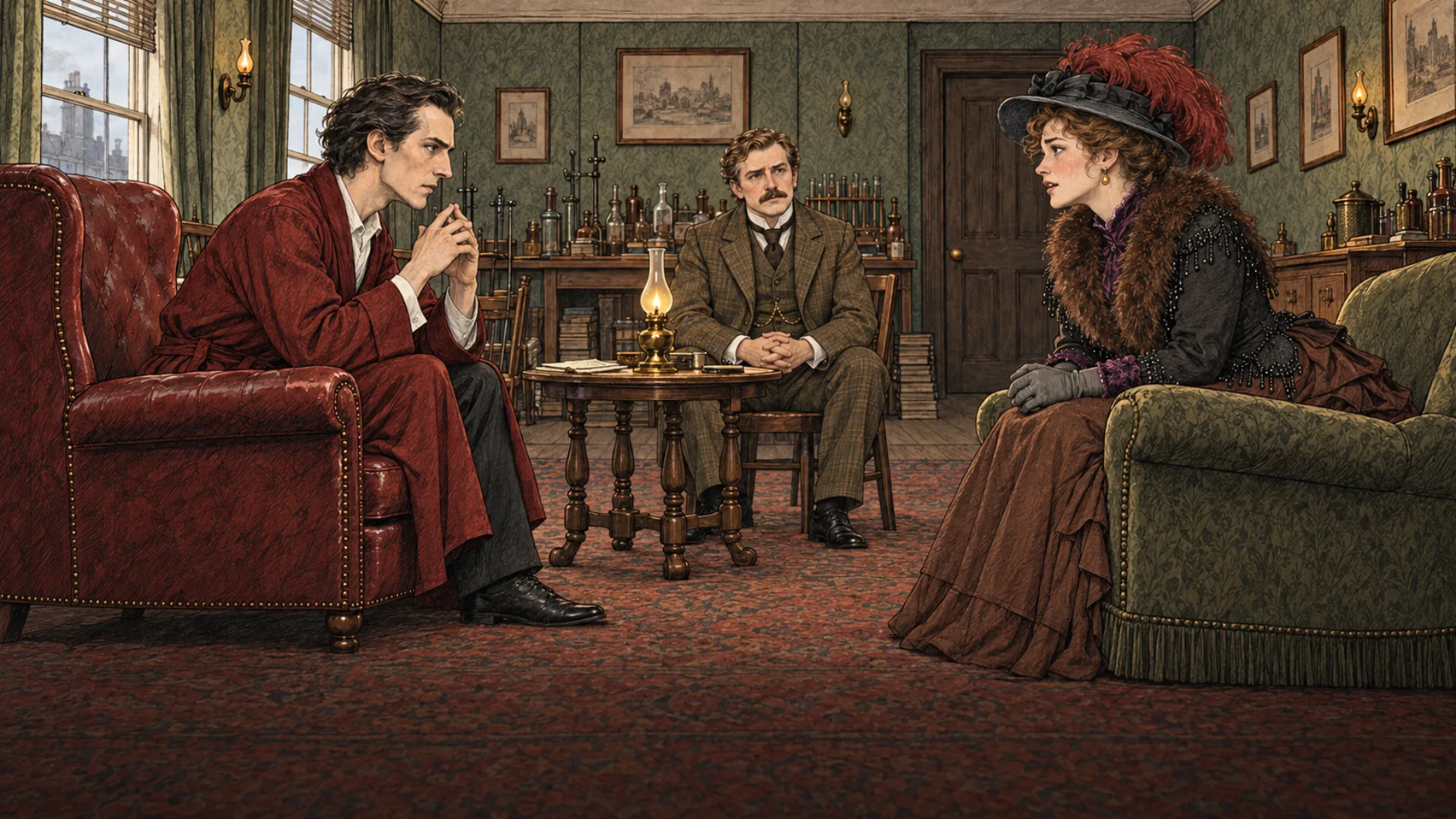
Mary appeals to Holmes to discover Hosmer Angel’s fate, offering all the money she can afford. When Holmes asks what drove her to act so quickly, she explains that her stepfather’s calm refusal to approach the police or seek help finally made her furious.
Japanese in this scene
- は
- は marks the topic of the sentence and can also contrast it with another topic. It is written ha but normally pronounced wa.
- が
- が marks the grammatical subject or introduces newly focused information. It can also connect clauses with a mild contrast.
- を
- を marks the direct object of a verb. With a movement verb, it can instead mark the route or place being crossed.
- に
- に can mark a destination, target, time, recipient, purpose, or resulting state. The predicate shows its role here.
Full text: original English and Japanese translation
"I came to you, sir, because I heard of you from Mrs. Etherege, whose husband you found so easy when the police and everyone had given him up for dead. Oh, Mr. Holmes, I wish you would do as much for me. I'm not rich, but still I have a hundred a year in my own right, besides the little that I make by the machine, and I would give it all to know what has become of Mr. Hosmer Angel."
「こちらに来たのは、エサリッジ夫人からお話を聞いたからです。警察もみんなも亡くなったものと諦めていたご主人を、あなたはいとも簡単に見つけてくださったそうです。ああ、ホームズさん、私にも同じようにしていただけたらと思います。私はお金持ちではありませんが、タイプを打って得るわずかなお金のほかに、自分の権利として年に百ポンドあります。ホズマー・エンジェルさんがどうなったか分かるのなら、全部差し上げても構いません」
"Why did you come away to consult me in such a hurry?" asked Sherlock Holmes, with his finger-tips together and his eyes to the ceiling.
「なぜそんなに急いで家を出て、私に相談にいらしたのですか」とシャーロック・ホームズは、指先を合わせ、天井へ目を向けて尋ねた。
Again a startled look came over the somewhat vacuous face of Miss Mary Sutherland. "Yes, I did bang out of the house," she said, "for it made me angry to see the easy way in which Mr. Windibank—that is, my father—took it all. He would not go to the police, and he would not go to you, and so at last, as he would do nothing and kept on saying that there was no harm done, it made me mad, and I just on with my things and came right away to you."
メアリー・サザーランド嬢の、いくぶんぼんやりした顔に、また驚きの表情が浮かんだ。「ええ、私は勢いよく家を出てきました」と彼女は言った。「だって、ウィンディバンクさん、つまり父が、何もかも平気な顔で受け止めているのを見て、腹が立ったんです。警察にも行こうとせず、あなたのところにも来ようとしないのです。それでとうとう、何もせず、別に何も悪いことは起きていないと言い続ける父に腹が立って、私はさっと身支度して、まっすぐこちらへ来たんです」