 よみうち英語Read the classics by typing
Notes Scene 9: A Question of Income
You've finished this scene
Notes on this scene
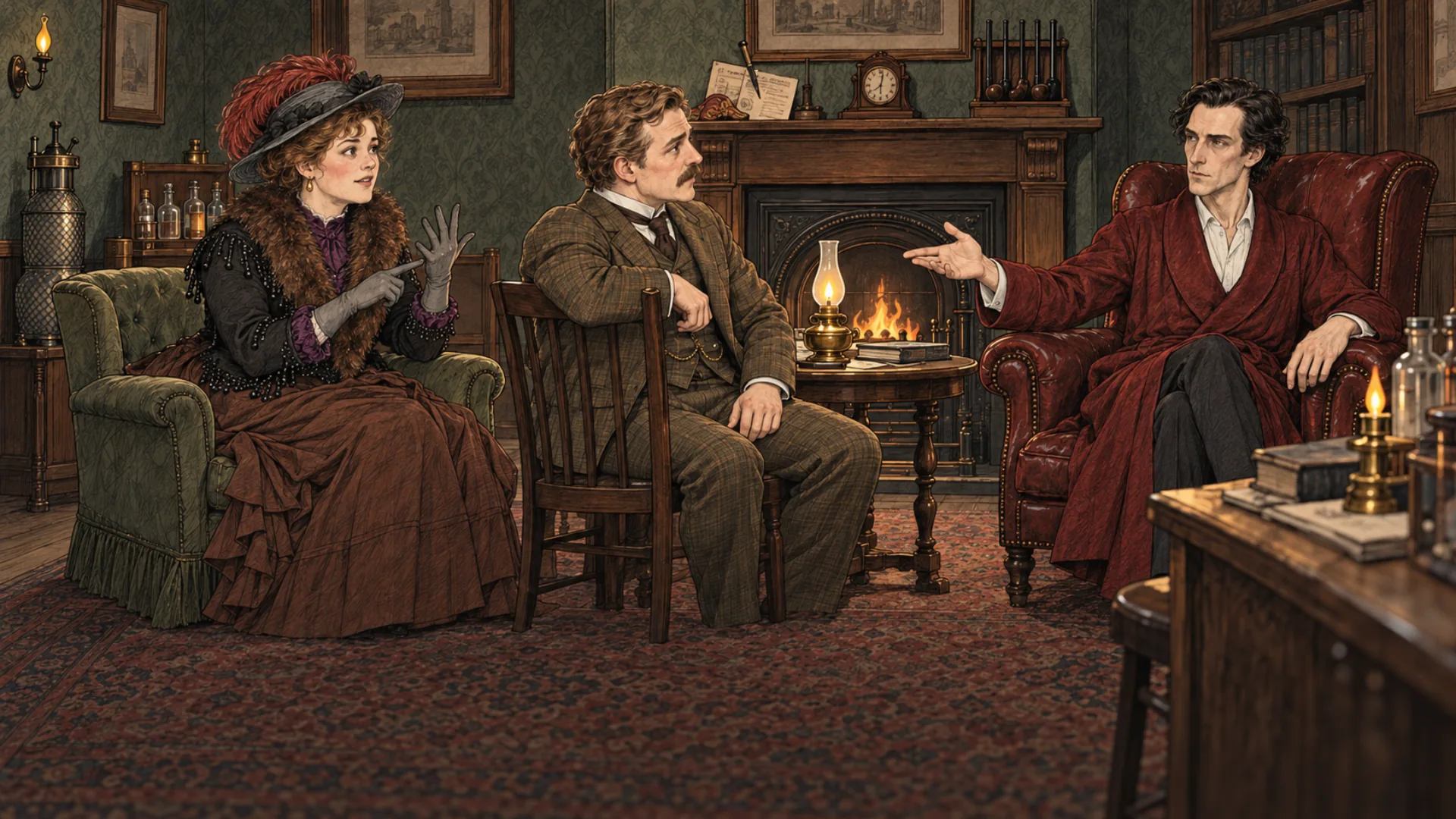
Holmes pays close attention to Mary’s apparently rambling story and asks where her independent income comes from. She explains that money left by her uncle is invested in New Zealand securities. The capital is beyond her reach, but it provides annual interest of one hundred pounds.
Japanese in this scene
- は
- は marks the topic of the sentence and can also contrast it with another topic. It is written ha but normally pronounced wa.
- が
- が marks the grammatical subject or introduces newly focused information. It can also connect clauses with a mild contrast.
- を
- を marks the direct object of a verb. With a movement verb, it can instead mark the route or place being crossed.
- に
- に can mark a destination, target, time, recipient, purpose, or resulting state. The predicate shows its role here.
Full text: original English and Japanese translation
I had expected to see Sherlock Holmes impatient under this rambling and inconsequential narrative, but, on the contrary, he had listened with the greatest concentration of attention.
このとりとめのない脈絡に乏しい話に、シャーロック・ホームズはいら立つだろうと思っていたが、逆に彼は、この上なく注意を集中して聞いていた。
"Your own little income," he asked, "does it come out of the business?"
「あなたご自身の収入は、その商売から得られるのですか」と彼は尋ねた。
"Oh, no, sir. It is quite separate and was left me by my uncle Ned in Auckland. It is in New Zealand stock, paying 4½ per cent. Two thousand five hundred pounds was the amount, but I can only touch the interest."
「いいえ、違います。それとはまったく別で、オークランドにいたネッド叔父が残してくれたものです。ニュージーランドの証券にしてあって、四パーセント半の利子が付きます。額は二千五百ポンドでしたが、私が使えるのは利子だけです」