 よみうち英語Read the classics by typing
Notes Scene 11: Memories of a Ball
You've finished this scene
Notes on this scene
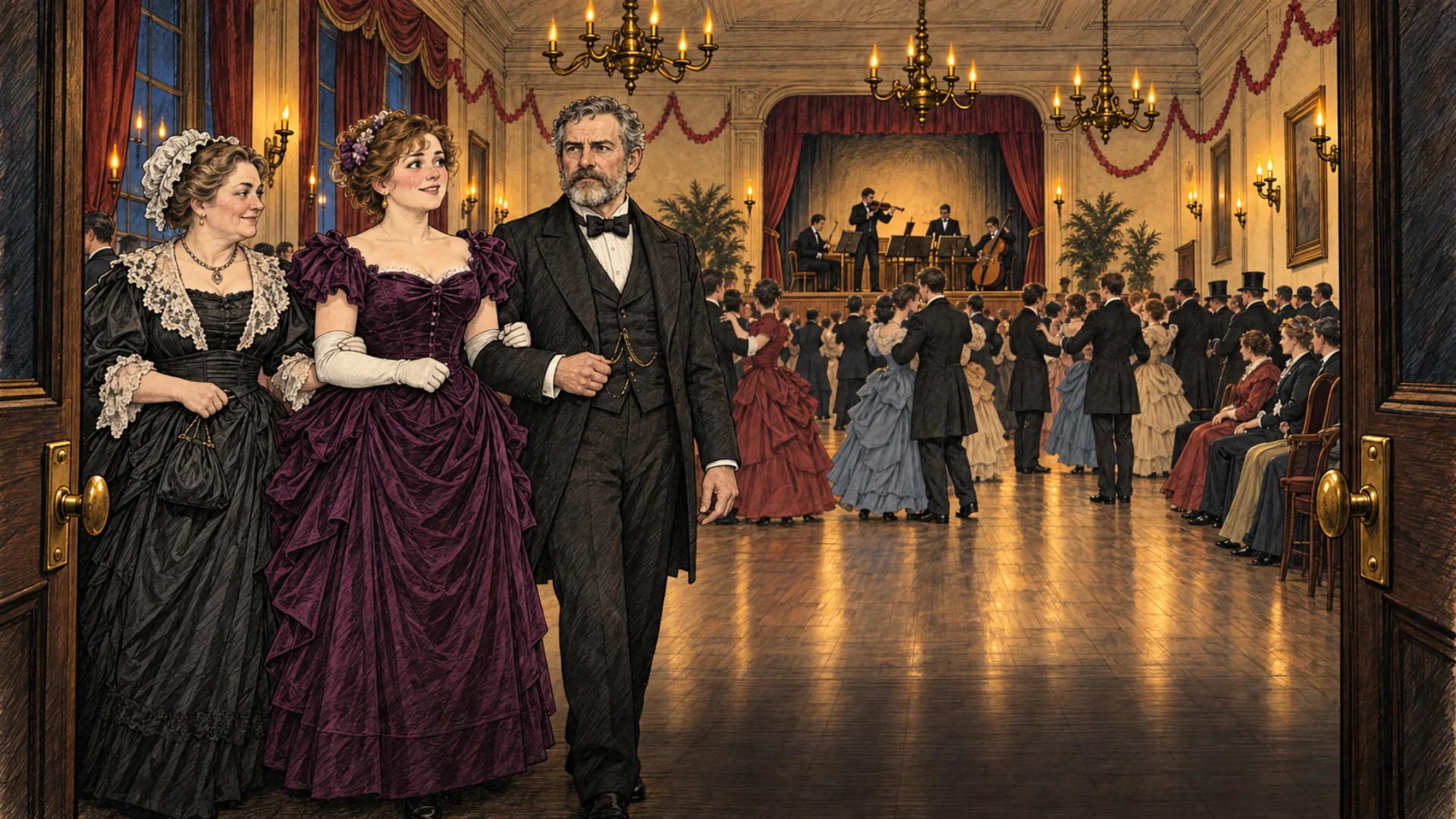
Mary describes how she attended the gasfitters’ ball despite her stepfather’s resistance. She went with her mother and Hardy, the former foreman of her late father’s business. At the dance she met Hosmer Angel, beginning the relationship that brought her to Baker Street.
Japanese in this scene
- は
- は marks the topic of the sentence and can also contrast it with another topic. It is written ha but normally pronounced wa.
- が
- が marks the grammatical subject or introduces newly focused information. It can also connect clauses with a mild contrast.
- を
- を marks the direct object of a verb. With a movement verb, it can instead mark the route or place being crossed.
- に
- に can mark a destination, target, time, recipient, purpose, or resulting state. The predicate shows its role here.
Full text: original English and Japanese translation
A flush stole over Miss Sutherland's face, and she picked nervously at the fringe of her jacket. "I met him first at the gasfitters' ball," she said. "They used to send father tickets when he was alive, and then afterwards they remembered us, and sent them to mother. Mr. Windibank did not wish us to go. He never did wish us to go anywhere. He would get quite mad if I wanted so much as to join a Sunday-school treat. But this time I was set on going, and I would go; for what right had he to prevent? He said the folk were not fit for us to know, when all father's friends were to be there. And he said that I had nothing fit to wear, when I had my purple plush that I had never so much as taken out of the drawer. At last, when nothing else would do, he went off to France upon the business of the firm, but we went, mother and I, with Mr. Hardy, who used to be our foreman, and it was there I met Mr. Hosmer Angel."
サザーランド嬢の顔に赤みがさし、彼女は上着の房飾りをそわそわといじった。「初めて会ったのは、ガス配管工の舞踏会でした」と彼女は言った。「父が生きていた頃はいつも入場券を送ってくれて、その後も私たちを忘れずに、母に送ってくれたんです。ウィンディバンクさんは、私たちに行ってほしくありませんでした。私たちがどこへ出かけるのも、いつだって嫌がる人でした。日曜学校の催しに加わりたいと思っただけでも、ひどく怒るんです。でも、このときはどうしても行くと決め、行くつもりでした。だって、あの人に止める権利がどこにあるのでしょう。あの人は、私たちが付き合うのにふさわしくない人たちだと言いましたけれど、父の友人たちはみんな来るはずでした。それに着ていくまともな服がないとも言いました。でも私は、一度も引き出しから出したことさえない、紫のプラッシュの服を持っていたんです。結局、どうにもならないと分かると、あの人は商会の仕事でフランスへ出かけました。でも私と母は、前にうちの職長だったハーディさんと出かけて、そこでホズマー・エンジェルさんに会ったんです」