 よみうち英語Read the classics by typing
Notes Scene 31: The Following Evening
You've finished this scene
Notes on this scene
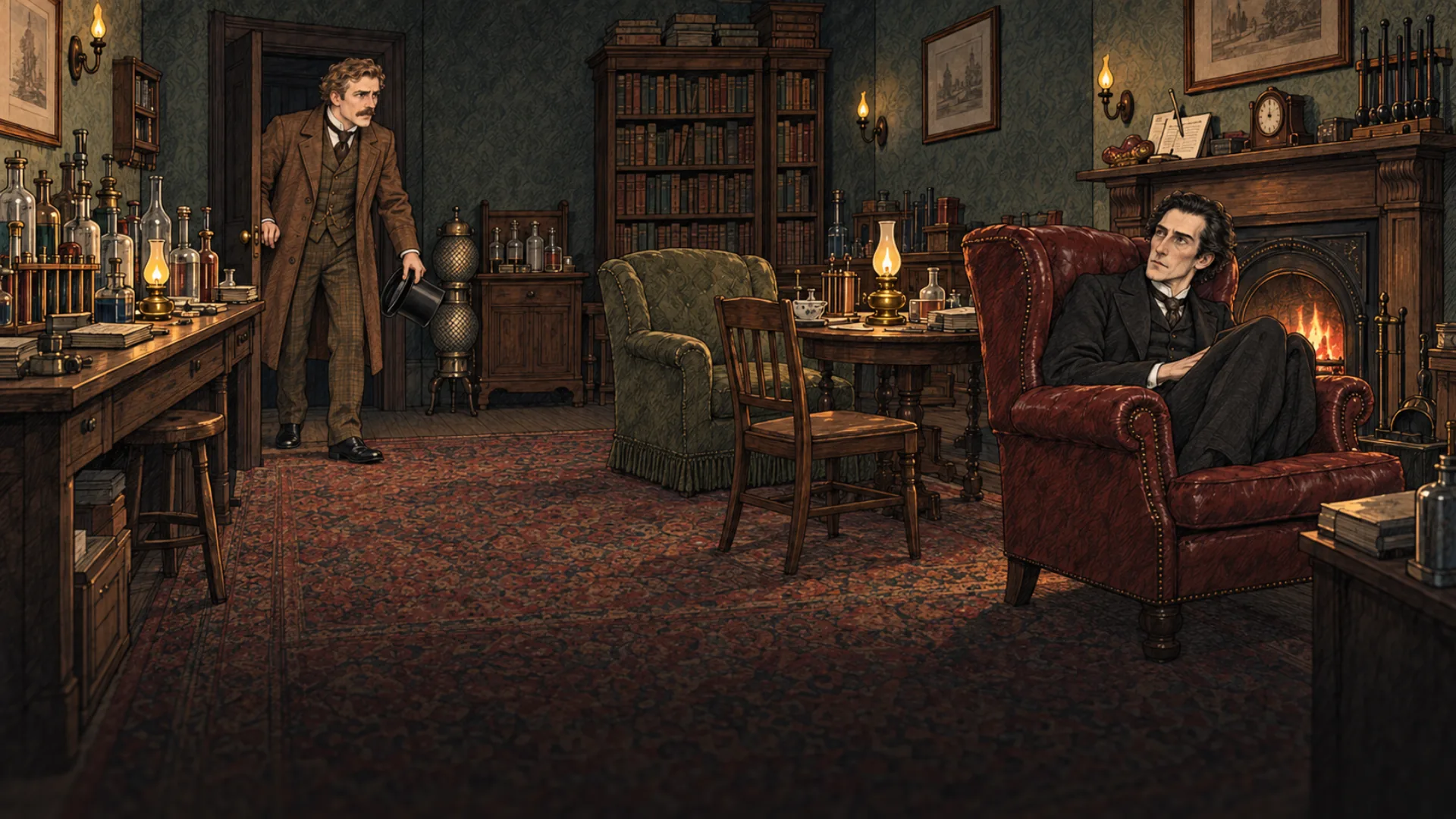
After finishing his medical duties, Watson reaches Baker Street shortly before six. He finds that Holmes has devoted the day to a chemical experiment. When Watson asks whether he has solved it, Holmes teasingly answers with the name of the chemical substance instead of the case.
Japanese in this scene
- は
- は marks the topic of the sentence and can also contrast it with another topic. It is written ha but normally pronounced wa.
- が
- が marks the grammatical subject or introduces newly focused information. It can also connect clauses with a mild contrast.
- を
- を marks the direct object of a verb. With a movement verb, it can instead mark the route or place being crossed.
- に
- に can mark a destination, target, time, recipient, purpose, or resulting state. The predicate shows its role here.
Full text: original English and Japanese translation
A professional case of great gravity was engaging my own attention at the time, and the whole of next day I was busy at the bedside of the sufferer. It was not until close upon six o'clock that I found myself free and was able to spring into a hansom and drive to Baker Street, half afraid that I might be too late to assist at the dénouement of the little mystery. I found Sherlock Holmes alone, however, half asleep, with his long, thin form curled up in the recesses of his armchair. A formidable array of bottles and test-tubes, with the pungent cleanly smell of hydrochloric acid, told me that he had spent his day in the chemical work which was so dear to him.
その頃、私は仕事で非常に重い症例を抱え、翌日は一日中、患者の病床に付き添っていた。ようやく手が空いたのは六時近くで、ハンサムに飛び乗りベイカー街へ向かった。このちょっとした謎の結末に立ち会うには、遅すぎるかもしれないと幾分心配していた。だがシャーロック・ホームズは一人きりで、細長い体を肘掛け椅子の奥に丸め、半ば眠っていた。ずらりと並んだ瓶や試験管と、塩酸の鼻を刺すような清潔なにおいから、彼が大好きな化学実験に一日を費やしていたことが分かった。
"Well, have you solved it?" I asked as I entered.
「さて、解けたのかい」と私は入って尋ねた。
"Yes. It was the bisulphate of baryta."
「そうだ。酸性硫酸バリウムだった」