 よみうち英語Read the classics by typing
Notes Scene 28: Silence by the Fire
You've finished this scene
Notes on this scene
After John leaves, Holmes silently studies the fire and smokes his pipe. Holmes calls the case exceptionally strange, while Watson recalls four earlier cases that rival it. Watson then asks what kind of danger threatens the family and what the repeated initials represent.
Japanese in this scene
- かもしれない
- かもしれない marks possibility: “might; may.” It presents the statement as uncertain rather than as a firm conclusion.
- ている
- The 〜ている form can show an action in progress, a continuing state, or the result of a completed action. The surrounding sentence decides which meaning applies.
- ように
- ように can express a goal, a desired result, or the manner in which something is done. It often follows a plain-form verb.
- について
- について means “about; concerning.” It attaches to the topic being discussed or investigated.
Full text: original English and Japanese translation
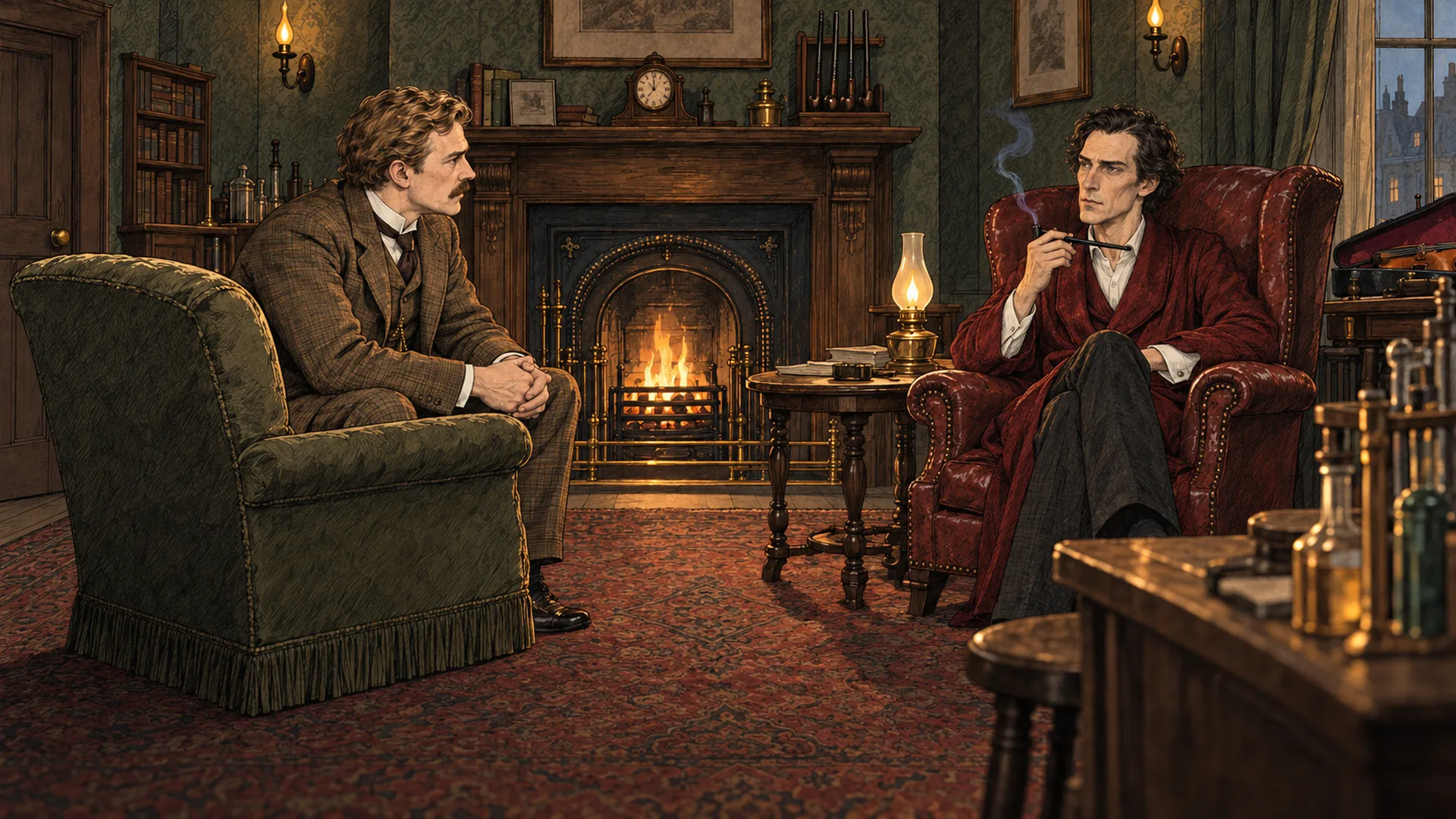
Sherlock Holmes sat for some time in silence, with his head sunk forward and his eyes bent upon the red glow of the fire. Then he lit his pipe, and leaning back in his chair he watched the blue smoke-rings as they chased each other up to the ceiling.
ホームズはしばらく黙ったまま、頭を前へ垂れ、赤く燃える火を見つめていた。やがてパイプに火をつけ、椅子にもたれて、青い煙の輪が追いかけ合いながら天井へ上るのを眺めた。
"I think, Watson," he remarked at last, "that of all our cases we have had none more fantastic than this."
「ワトソン」と、ついに彼は言った。「これまでの事件の中でも、これほど奇怪なものはなかったと思うね」
"Save, perhaps, the Sign of Four."
「『四つの署名』は別かもしれないが」
"Well, yes. Save, perhaps, that. And yet this John Openshaw seems to me to be walking amid even greater perils than did the Sholtos."
「ああ、そうだな。あれは別かもしれない。それでも、このジョン・オープンショーは、ショルトー家の人々より、さらに大きな危険の中を歩いているように思える」
"But have you," I asked, "formed any definite conception as to what these perils are?"
「だが、その危険が何なのか」と私は尋ねた。「はっきりした考えはできているのかい」
"There can be no question as to their nature," he answered.
「危険の性質については、疑う余地がない」と彼は答えた。
"Then what are they? Who is this K. K. K., and why does he pursue this unhappy family?"
「では、何なんだ。このK・K・Kとは誰で、なぜこの不幸な一族を追い回すんだろう」