 よみうち英語Read the classics by typing
Notes Scene 3: Begin Again, Please
You've finished this scene
Notes on this scene
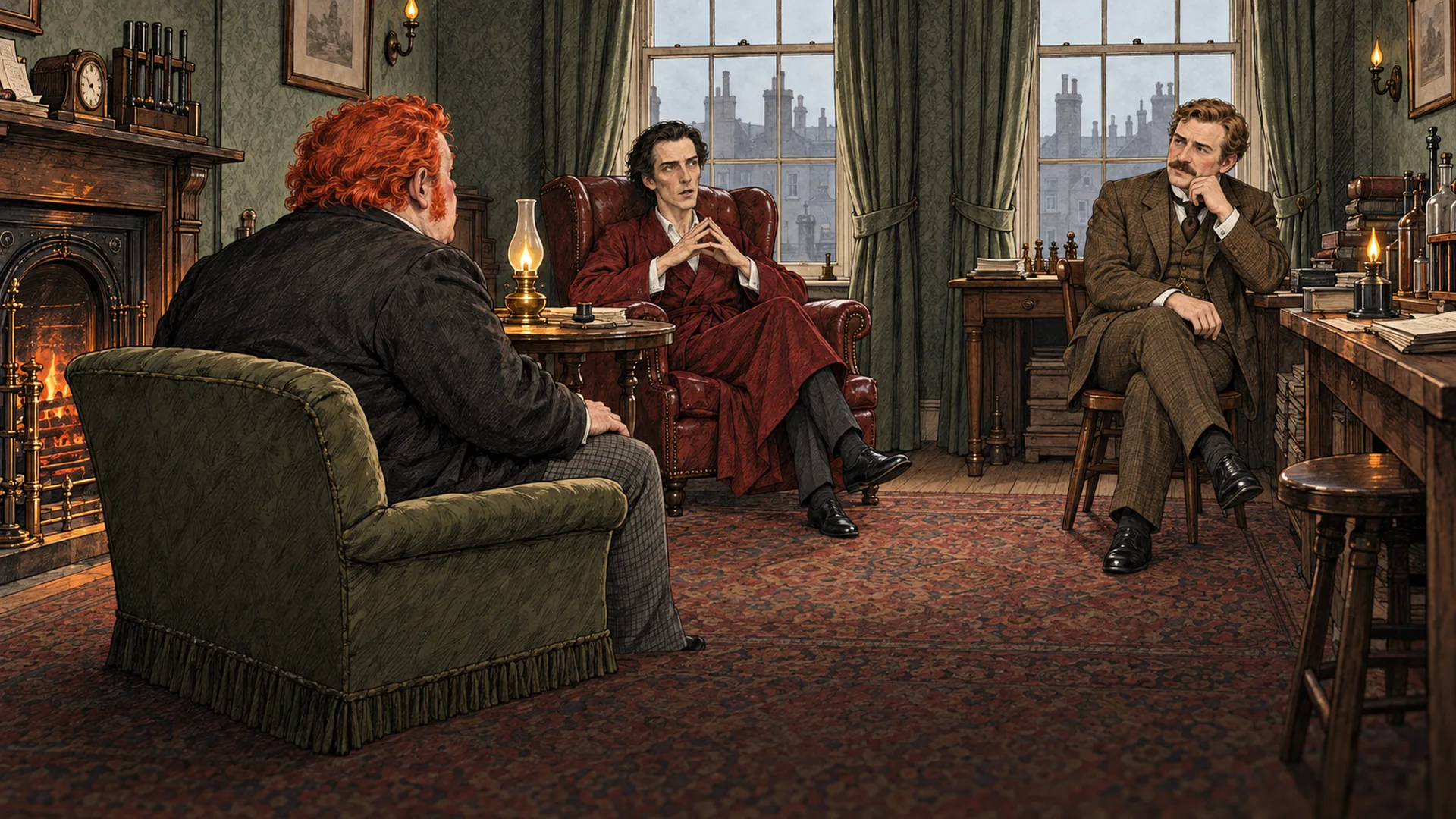
Holmes promises to pile fact upon fact until Watson accepts his view. He describes Wilson’s story as extraordinarily strange, although he cannot yet say whether it involves a crime. For Watson’s benefit and to preserve every detail, Holmes asks their visitor to repeat the account from the beginning.
Japanese in this scene
- ている
- The 〜ている form can show an action in progress, a continuing condition, or the present result of a completed action. The surrounding context selects the meaning.
- という
- という connects quoted words, a name, or an idea to the noun that follows. Depending on context, it can mean “called,” “that,” or “the idea that.”
- そうな
- The stem of an adjective or verb + そうな modifies a noun with the sense “looks likely to…” or “appears….” It is based on visible impression.
- は
- は marks the topic of a sentence and can also set up a contrast with another item.
Background
- Doctor
- Watson is a former army surgeon who later practices medicine in London. Holmes often addresses him warmly as “Doctor”; the Japanese translation uses 先生, a respectful form of address for doctors and teachers.
Full text: original English and Japanese translation
"You did, Doctor, but none the less you must come round to my view, for otherwise I shall keep on piling fact upon fact on you until your reason breaks down under them and acknowledges me to be right. Now, Mr. Jabez Wilson here has been good enough to call upon me this morning, and to begin a narrative which promises to be one of the most singular which I have listened to for some time. You have heard me remark that the strangest and most unique things are very often connected not with the larger but with the smaller crimes, and occasionally, indeed, where there is room for doubt whether any positive crime has been committed. As far as I have heard, it is impossible for me to say whether the present case is an instance of crime or not, but the course of events is certainly among the most singular that I have ever listened to. Perhaps, Mr. Wilson, you would have the great kindness to recommence your narrative. I ask you not merely because my friend Dr. Watson has not heard the opening part but also because the peculiar nature of the story makes me anxious to have every possible detail from your lips. As a rule, when I have heard some slight indication of the course of events, I am able to guide myself by the thousands of other similar cases which occur to my memory. In the present instance I am forced to admit that the facts are, to the best of my belief, unique."
「そうだったね、先生。だがそれでも、きみは私の考えに折れるしかない。さもなければ、きみの理性が重みに耐えかねて私の正しさを認めるまで、私は事実の上に事実を積み上げ続けるからね。さて、こちらのジェイベズ・ウィルソンさんがけさわざわざ訪ねてきて、話を始めてくれたのだが、これがここしばらく聞いた中でも指折りの奇妙な話になりそうなのだ。私がよく言うのを聞いているだろう。いちばん奇妙で類のない出来事は、大きな犯罪よりもむしろ小さな犯罪に結びついていることが実に多く、ときには、そもそも本当に犯罪が行われたのかどうかさえ疑わしい場合もある、とね。ここまで聞いたかぎりでは、今度の件が犯罪なのかどうか、私にはまだ何とも言えないが、事の成り行きがこれまで聞いた中でもとびきり奇妙な部類に入るのは確かだ。ウィルソンさん、お手数だが、お話を初めからもう一度聞かせてもらえないだろうか。こうお願いするのは、友人のワトソン先生が話の初めを聞いていないからだけではない。話が風変わりなので、細かな点まで残らずあなたの口から聞いておきたいからなのだ。ふだんなら、事の成り行きを少し聞いただけで、記憶に浮かぶ何千という似た事件を手がかりに見当をつけられる。だが今回ばかりは、私の知るかぎり、ほかに例のない事実だと認めざるをえない」