 よみうち英語Read the classics by typing
Notes Scene 9: The League's Notice
You've finished this scene
Notes on this scene
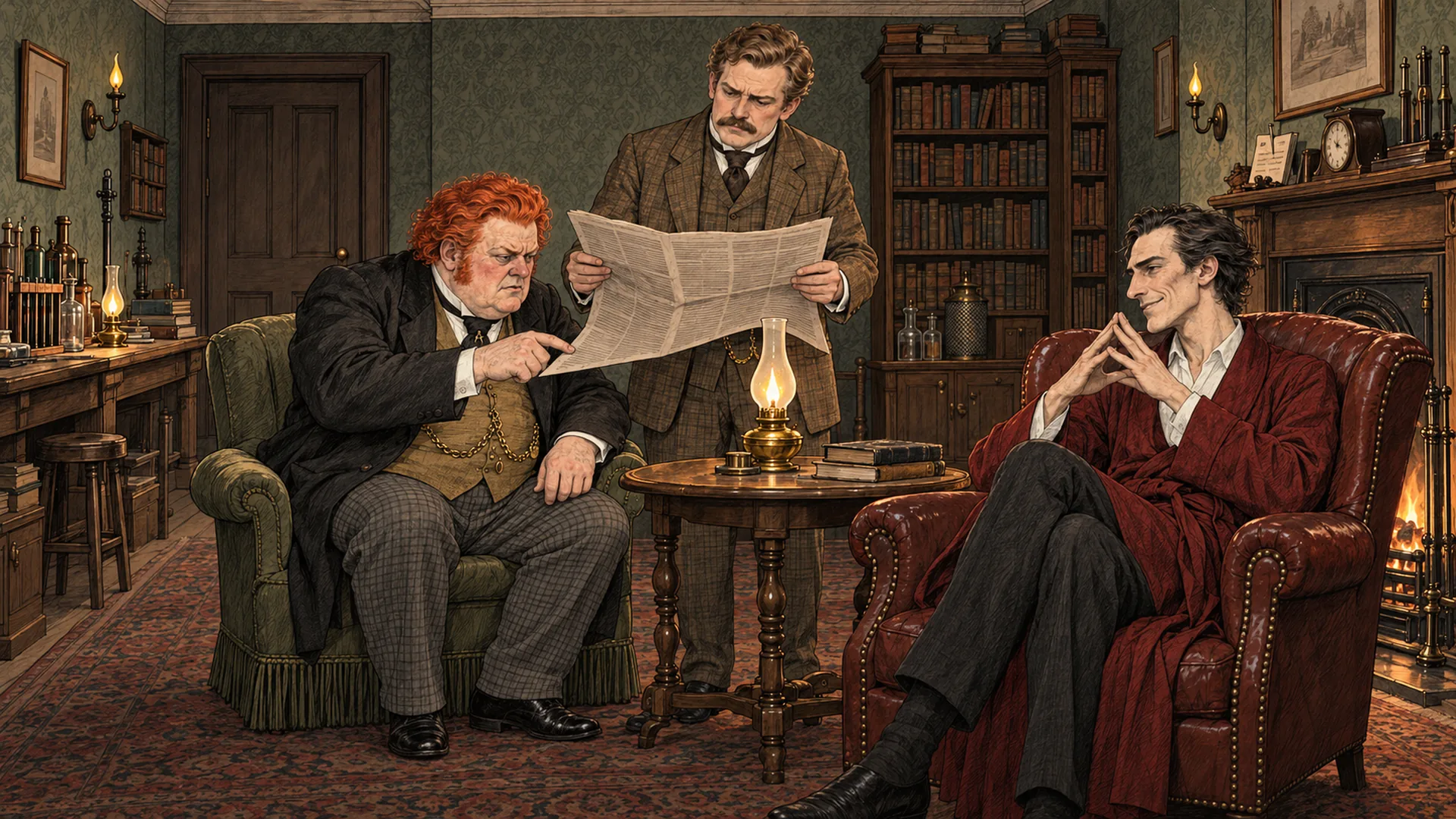
The advertisement announces a vacancy in the Red-Headed League and promises four pounds a week for nominal services. Applicants must be healthy red-haired men at least twenty-one years old. Holmes becomes visibly pleased, asks Wilson for his full story, and tells Watson to record the newspaper’s name and date.
Japanese in this scene
- ている
- The 〜ている form can show an action in progress, a continuing condition, or the present result of a completed action. The surrounding context selects the meaning.
- ような
- ような links a comparison or example to a following noun: “like; such as.” It is the noun-modifying form corresponding to ように.
- ながら
- Verb stem + ながら means doing two actions at the same time: “while doing….” The action after ながら is normally the main one.
- は
- は marks the topic of a sentence and can also set up a contrast with another item.
Background
- Four pounds a week
- A Victorian clerk might earn one or two pounds a week, and even a skilled worker often earned around two. Four pounds for four hours of nominal work each day is therefore an exceptionally generous wage.
Full text: original English and Japanese translation
I took the paper from him and read as follows:
私は彼から新聞を受け取り、次のような文面を読んだ。
"TO THE RED-HEADED LEAGUE: On account of the bequest of the late Ezekiah Hopkins, of Lebanon, Pennsylvania, U.S.A., there is now another vacancy open which entitles a member of the League to a salary of £ 4 a week for purely nominal services. All red-headed men who are sound in body and mind and above the age of twenty-one years, are eligible. Apply in person on Monday, at eleven o'clock, to Duncan Ross, at the offices of the League, 7 Pope's Court, Fleet Street."
「赤毛組合――米国ペンシルヴェニア州レバノンの故イジーカイア・ホプキンズ氏の遺贈により、組合員に週四ポンドの給料が支払われる、まったく名目だけの職に、このたび再び欠員が生じた。心身ともに健康な二十一歳以上の赤毛の男子であれば、だれでも応募資格がある。月曜日の十一時に、フリート街ポープス・コート七番地の組合事務所にて、ダンカン・ロスまで本人が直接申し込まれたし」
"What on earth does this mean?" I ejaculated after I had twice read over the extraordinary announcement.
「いったいこれはどういう意味だい?」この奇妙な告知を二度読み返したあと、私は思わず叫んだ。
Holmes chuckled and wriggled in his chair, as was his habit when in high spirits. "It is a little off the beaten track, isn't it?" said he. "And now, Mr. Wilson, off you go at scratch and tell us all about yourself, your household, and the effect which this advertisement had upon your fortunes. You will first make a note, Doctor, of the paper and the date."
ホームズは、上機嫌なときのいつもの癖で、くすくす笑いながら椅子の上で身をよじった。「ちょっとありきたりの道から外れているね、そうだろう?」と彼は言った。「では、ウィルソンさん、スタートラインから一気にどうぞ。あなたご自身のこと、お宅のこと、そしてこの広告があなたの運命にどう響いたのかを、すっかり聞かせてもらおう。先生、まずは新聞の名前と日付を書き留めておいてくれたまえ」