 よみうち英語Read the classics by typing
Notes Scene 29: What the Card Said
You've finished this scene
Notes on this scene
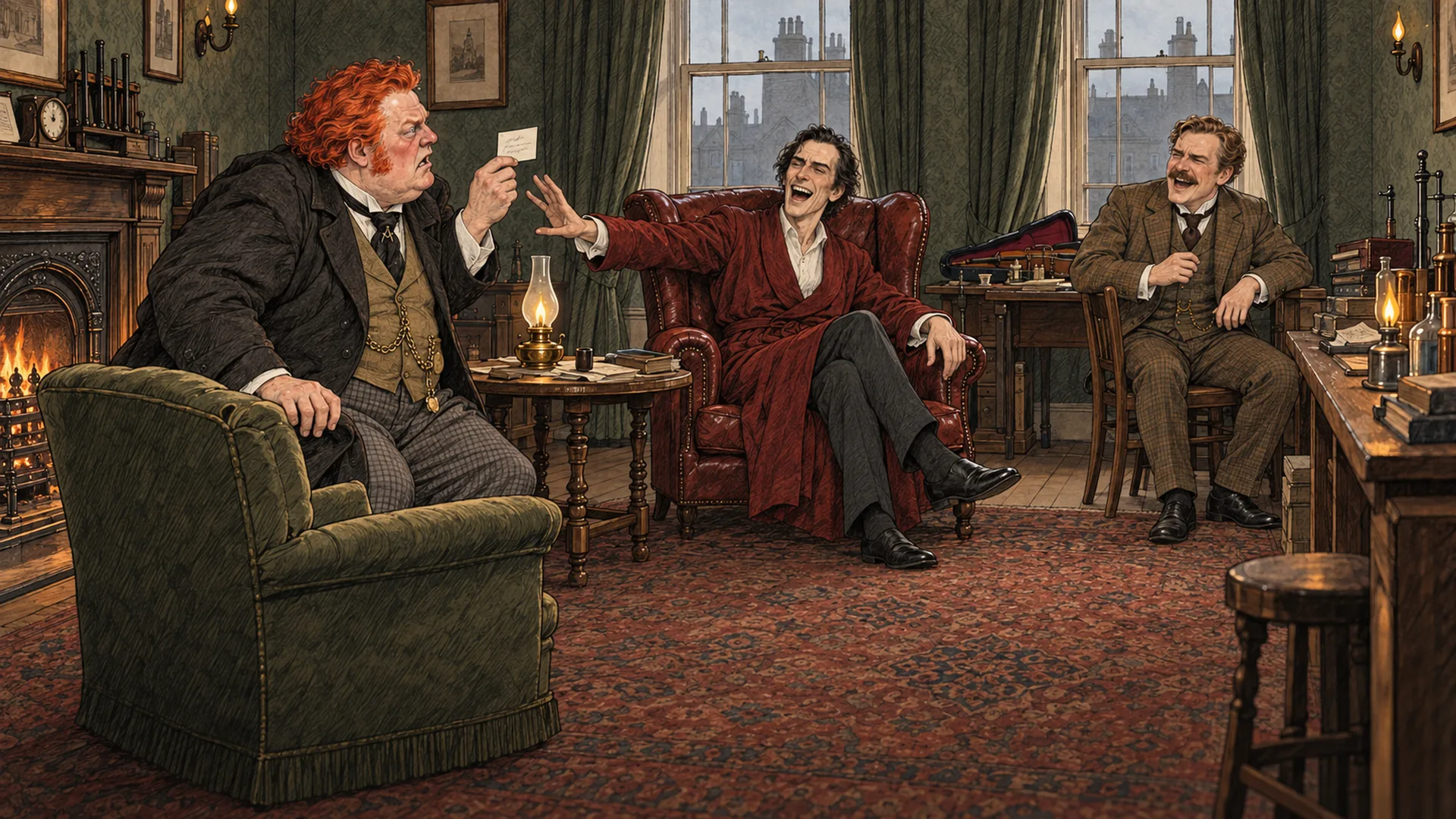
The card says only that the Red-Headed League has been dissolved. The announcement and Wilson’s unhappy expression make Holmes and Watson laugh aloud. Offended, Wilson threatens to leave, but Holmes calms him, insists that they would not miss his case, and asks how he responded to the discovery.
Japanese in this scene
- ていた
- The 〜ていた form is the past of 〜ている. It describes an action that was in progress or a state that continued at the time being discussed.
- ような
- ような links a comparison or example to a following noun: “like; such as.” It is the noun-modifying form corresponding to ように.
- そうな
- The stem of an adjective or verb + そうな modifies a noun with the sense “looks likely to…” or “appears….” It is based on visible impression.
- ばかり
- ばかり can mean “only,” “nothing but,” or “just did,” depending on the form before it. It focuses attention on a narrow range or recent action.
Background
- The dates
- The advertisement is dated April 27 and called two months old, but the dissolution notice says October 9 and the story begins in autumn. The inconsistency belongs to Conan Doyle’s original story.
Full text: original English and Japanese translation
He held up a piece of white cardboard about the size of a sheet of note-paper. It read in this fashion:
彼は便箋一枚ほどの大きさの白い厚紙をかざしてみせた。そこにはこう書かれていた。
"THE RED-HEADED LEAGUE IS DISSOLVED. October 9, 1890."
「赤毛組合は解散いたしました。一八九〇年十月九日」
Sherlock Holmes and I surveyed this curt announcement and the rueful face behind it, until the comical side of the affair so completely overtopped every other consideration that we both burst out into a roar of laughter.
シャーロック・ホームズと私は、このそっけない告知と、その向こうの情けなさそうな顔とを見比べていたが、やがて事の滑稽さがほかのあらゆる思いをすっかり押しのけてしまい、二人そろって大声で笑いだした。
"I cannot see that there is anything very funny," cried our client, flushing up to the roots of his flaming head. "If you can do nothing better than laugh at me, I can go elsewhere."
「何がそんなにおかしいのか、私にはさっぱりわかりませんがね」と依頼人は叫び、燃えるような赤毛の生えぎわまで真っ赤になった。「私を笑うことしかできないのなら、よそへ参りますよ」
"No, no," cried Holmes, shoving him back into the chair from which he had half risen. "I really wouldn't miss your case for the world. It is most refreshingly unusual. But there is, if you will excuse my saying so, something just a little funny about it. Pray what steps did you take when you found the card upon the door?"
「いやいや」とホームズは叫び、腰を浮かしかけた彼を椅子へ押し戻した。「あなたの事件を聞き逃すなど、とんでもない。実に新鮮で、めったにない事件だ。だが、こう言っては失礼だが、少しばかりおかしなところがあるのも確かでね。それで、ドアの貼り紙を見つけて、あなたはどうしたのかね?」