 よみうち英語Read the classics by typing
Notes Scene 40: Saxe-Coburg Square
You've finished this scene
Notes on this scene
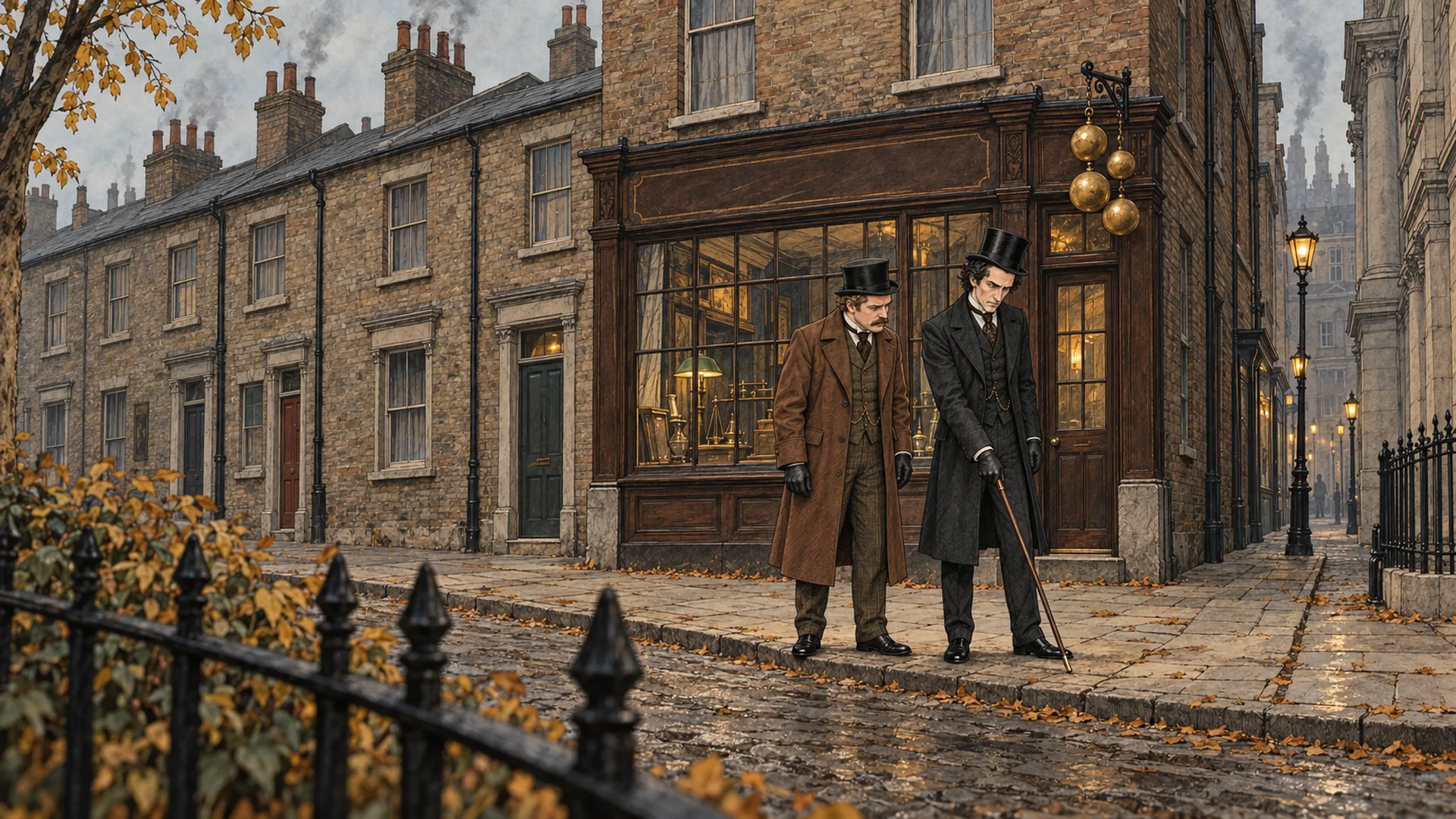
Holmes and Watson reach the worn, quiet square and locate Jabez Wilson’s pawnbroker’s shop. Holmes studies the premises, strikes the pavement several times with his stick, and then knocks at the door. A clean, intelligent-looking young man answers, allowing Holmes his first direct look at Wilson’s assistant.
Japanese in this scene
- ていた
- The 〜ていた form is the past of 〜ている. It describes an action that was in progress or a state that continued at the time being discussed.
- そうな
- The stem of an adjective or verb + そうな modifies a noun with the sense “looks likely to…” or “appears….” It is based on visible impression.
- ながら
- Verb stem + ながら means doing two actions at the same time: “while doing….” The action after ながら is normally the main one.
- だけ
- だけ means “only; just; as much as.” Unlike しか, it does not require a negative predicate.
Background
- The pawnbroker’s sign
- Three gilded balls traditionally marked a British pawnbroker. The symbol may derive from the arms of the Medici family and was recognizable even to customers who could not read.
- The London Underground
- London opened the world’s first underground railway in 1863. Steam locomotives originally pulled the trains, and Aldersgate—now Barbican—was one of the early stations.
Full text: original English and Japanese translation
We travelled by the Underground as far as Aldersgate; and a short walk took us to Saxe-Coburg Square, the scene of the singular story which we had listened to in the morning. It was a poky, little, shabby-genteel place, where four lines of dingy two-storied brick houses looked out into a small railed-in enclosure, where a lawn of weedy grass and a few clumps of faded laurel bushes made a hard fight against a smoke-laden and uncongenial atmosphere. Three gilt balls and a brown board with "JABEZ WILSON" in white letters, upon a corner house, announced the place where our red-headed client carried on his business. Sherlock Holmes stopped in front of it with his head on one side and looked it all over, with his eyes shining brightly between puckered lids. Then he walked slowly up the street, and then down again to the corner, still looking keenly at the houses. Finally he returned to the pawnbroker's, and, having thumped vigorously upon the pavement with his stick two or three times, he went up to the door and knocked. It was instantly opened by a bright-looking, clean-shaven young fellow, who asked him to step in.
私たちは地下鉄でオールダーズゲートまで行き、そこから少し歩いて、朝に聞いたあの奇妙な話の舞台、サックス・コバーグ・スクエアに着いた。そこは狭苦しく、ちっぽけで、落ちぶれながらも体裁だけはつくろった場所で、くすんだ二階建てのれんがの家が四方に並んで、柵に囲まれた小さな空き地を見下ろしており、その空き地では、雑草まじりの芝生と、色あせた月桂樹の茂みがいくつか、煤煙を含んだ肌に合わない空気を相手に、苦しい戦いを続けていた。角の一軒には、金色の玉が三つと、白い文字で「ジェイベズ・ウィルソン」と書かれた茶色の看板が掲げられ、そこが赤毛の依頼人の商う店であることを示していた。シャーロック・ホームズはその前で立ち止まって首をかしげ、細めたまぶたのあいだから目をきらきらと光らせながら、店をくまなく眺めた。それから彼は通りをゆっくりと歩いて行き、また角まで戻ってきたが、そのあいだも家々を鋭く見つめ続けていた。最後に彼は質屋の前に戻ると、ステッキで歩道を二、三度強く叩いてから、戸口へ歩み寄ってノックした。ドアはすぐに開き、利口そうな顔つきの、ひげをきれいに剃った若い男が、どうぞ中へと彼を招いた。