 よみうち英語Read the classics by typing
Notes Scene 44: The Order of the Houses
You've finished this scene
Notes on this scene
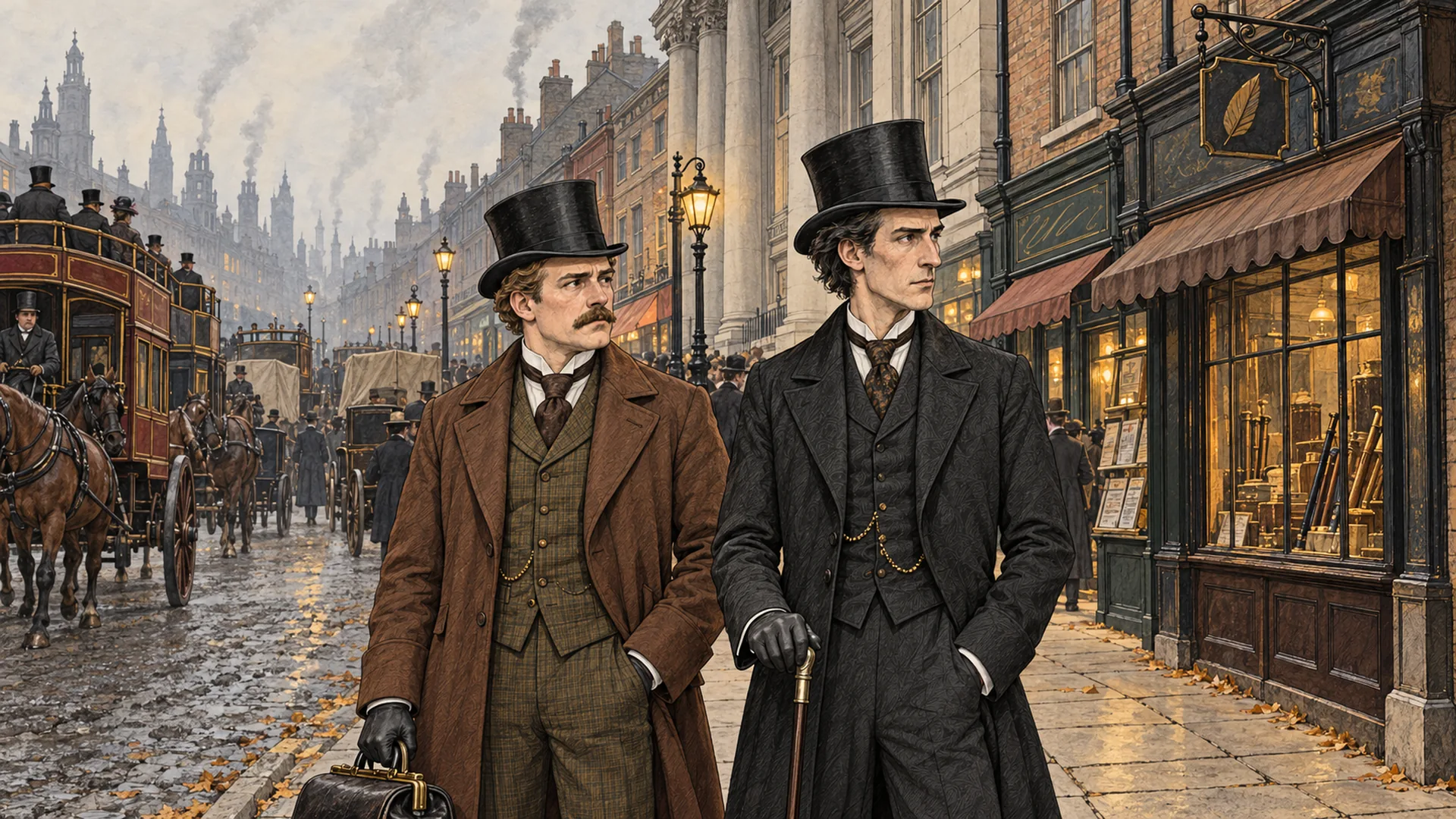
Holmes carefully identifies the businesses behind Wilson’s shop, including a newspaper seller, a bank branch, a restaurant, and a carriage builder. He claims that exact knowledge of London is useful to him. Having completed this part of the inquiry, he turns toward food and the world of music.
Japanese in this scene
- ておく
- Verb + ておく means doing something in advance or leaving a result in place for later. In speech, it often contracts to 〜とく.
- ながら
- Verb stem + ながら means doing two actions at the same time: “while doing….” The action after ながら is normally the main one.
- たら
- The past-form verb + ら creates a conditional meaning “if; when.” It can describe either a hypothetical condition or what was discovered after an action.
- たい
- The verb stem + たい expresses the speaker’s desire to act: “want to….” It conjugates like an i-adjective.
Background
- Vegetarian restaurant
- The Vegetarian Society was founded in Britain in 1847, and vegetarian restaurants appeared in late Victorian London. Meat-free dining was a modern fashion associated with health and ethical reform.
Full text: original English and Japanese translation
"Let me see," said Holmes, standing at the corner and glancing along the line, "I should like just to remember the order of the houses here. It is a hobby of mine to have an exact knowledge of London. There is Mortimer's, the tobacconist, the little newspaper shop, the Coburg branch of the City and Suburban Bank, the Vegetarian Restaurant, and McFarlane's carriage-building depot. That carries us right on to the other block. And now, Doctor, we've done our work, so it's time we had some play. A sandwich and a cup of coffee, and then off to violin-land, where all is sweetness and delicacy and harmony, and there are no red-headed clients to vex us with their conundrums."
「さてと」と、ホームズは角に立って並びに目を走らせながら言った。「ここに並ぶ建物の順番を覚えておきたいんだ。ロンドンを正確に知っておくのが、私の道楽でね。たばこ屋のモーティマー、小さな新聞屋、シティ・アンド・サバーバン銀行のコバーグ支店、菜食レストラン、それにマクファーレンの馬車製造所だ。これで、向こうの区画までちょうどつながる。さて、先生、仕事は済んだから、そろそろ遊びの時間だ。サンドイッチとコーヒーを一杯やったら、ヴァイオリンの国へ出かけよう。何もかもが甘美で繊細で調和に満ち、厄介ななぞなぞで私たちを悩ませる赤毛の依頼人もいない国へね」