 よみうち英語Read the classics by typing
Notes Scene 30: To Stoke Moran
You've finished this scene
Notes on this scene
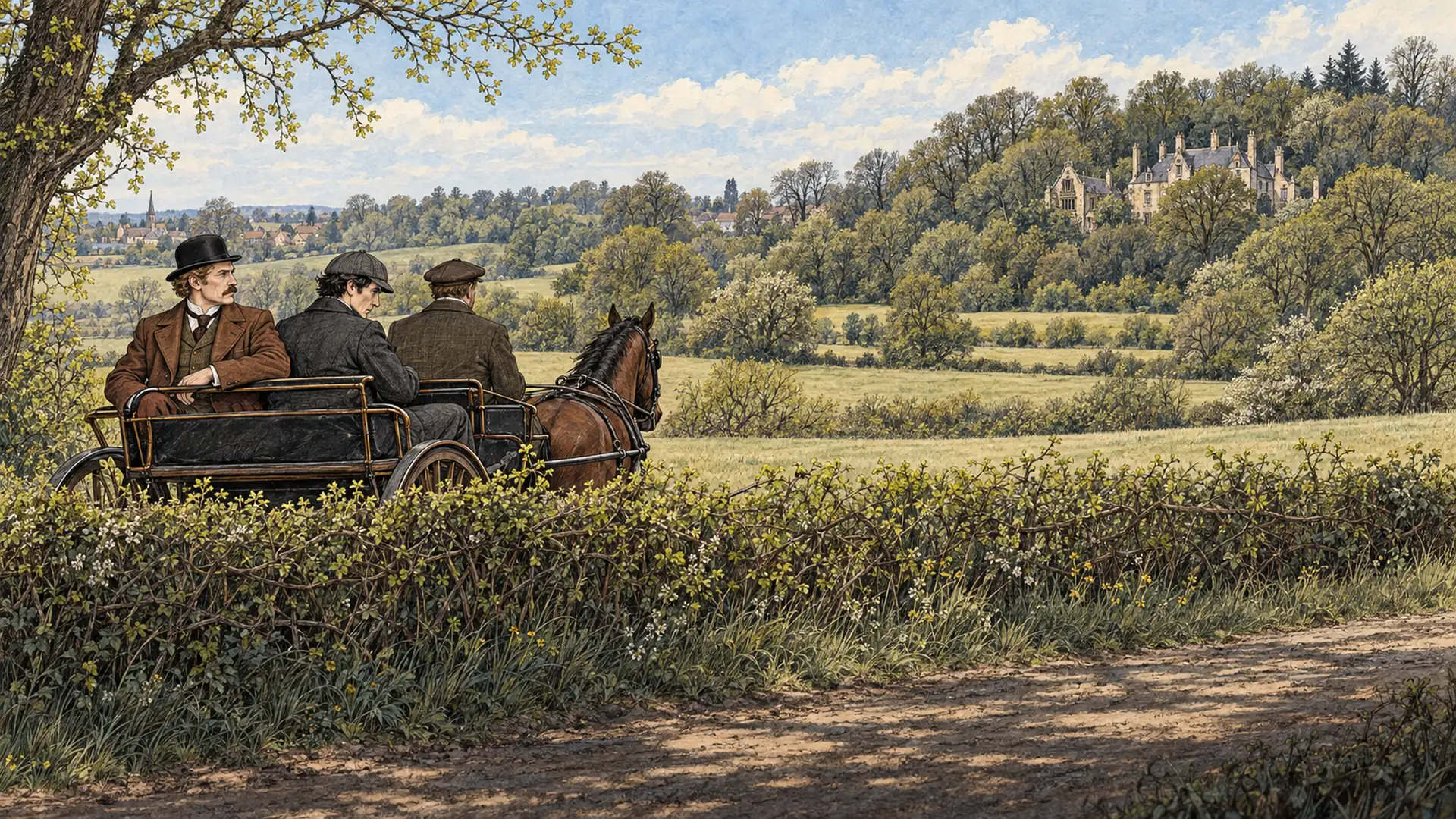
Holmes and Watson take a train from Waterloo, hire a carriage at Leatherhead, and travel through the Surrey countryside. Spring fills the road and fields, but Holmes sits with folded arms, absorbed in thought. Suddenly he touches Watson's shoulder and points across the landscape toward something in the distance. The scene begins from this carefully established point.
Japanese in this scene
- 少なくとも私には
- 少なくとも limits the observation to Watson's viewpoint: at least to him, spring's promise contrasts strangely with their grim investigation.
- ところが突然、彼ははっとして
- ところが marks a sudden interruption to the quiet journey: Holmes abruptly notices something and points across the meadow.
- いちばん高いところで
- いちばん marks the highest point of the rising grounds, where the garden gives way to thicker woodland.
- でがす
- でがす is the driver's rustic or nonstandard form of です. It characterizes his speech while he points out Roylott's house.
Background
- trap
- A trap was a light carriage, often with two wheels and one horse. Such vehicles could be hired near rural stations for journeys to villages and estates.
Full text: original English and Japanese translation
At Waterloo we were fortunate in catching a train for Leatherhead, where we hired a trap at the station inn and drove for four or five miles through the lovely Surrey lanes. It was a perfect day, with a bright sun and a few fleecy clouds in the heavens. The trees and wayside hedges were just throwing out their first green shoots, and the air was full of the pleasant smell of the moist earth. To me at least there was a strange contrast between the sweet promise of the spring and this sinister quest upon which we were engaged. My companion sat in the front of the trap, his arms folded, his hat pulled down over his eyes, and his chin sunk upon his breast, buried in the deepest thought. Suddenly, however, he started, tapped me on the shoulder, and pointed over the meadows.
ウォータールー駅では運よくレザーヘッド行きの列車に間に合い、駅の宿で二輪馬車を借りて、サリー州の美しい小道を四、五マイル走った。申し分のない日で、陽は明るく、空にはちぎれ雲が少し浮かんでいた。木々や道端の生け垣は最初の緑の芽を吹き出したばかりで、大気は湿った土の心地よい匂いに満ちていた。少なくとも私には、春の甘やかな約束と、私たちが従事しているこの不吉な探索とのあいだに、奇妙な対照が感じられた。連れは馬車の前方に座り、腕を組み、帽子を目深にかぶり、あごを胸に沈めて、深い思索に沈み込んでいた。ところが突然、彼ははっとして、私の肩をたたき、牧草地の向こうを指さした。
"Look there!" said he.
「あれを見たまえ」と彼は言った。
A heavily timbered park stretched up in a gentle slope, thickening into a grove at the highest point. From amid the branches there jutted out the grey gables and high roof-tree of a very old mansion.
木立の深い庭園がなだらかな斜面となって上へ伸び、いちばん高いところで茂みの森に変わっていた。枝のあいだから、ごく古い屋敷の灰色の切妻と高い棟木が突き出ていた。
"Stoke Moran?" said he.
「ストーク・モランだな」と彼は言った。
"Yes, sir, that be the house of Dr. Grimesby Roylott," remarked the driver.
「へえ、旦那、あれがグリムズビー・ロイロット博士のお屋敷でがす」と御者が言った。