 よみうち英語Read the classics by typing
Notes Scene 5: I See, I Deduce
You've finished this scene
Notes on this scene
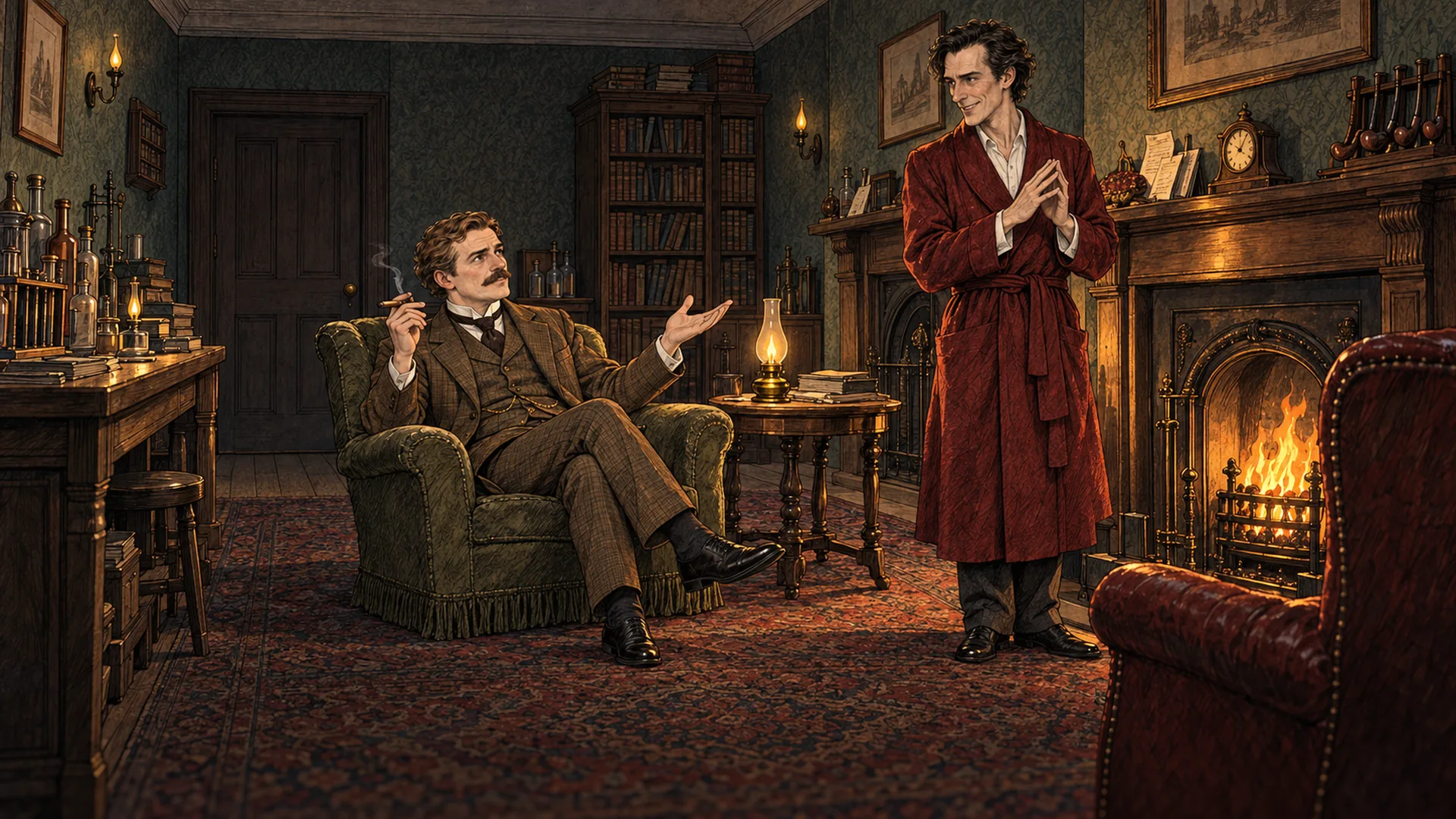
Holmes says that observation and deduction reveal Watson’s wet outing and his servant’s carelessness. Watson admits both facts but cannot see how Holmes inferred them, particularly after Watson changed his clothes. He says that his wife has already dismissed Mary Jane. Holmes responds with a private chuckle, rubbing his hands together.
Japanese in this scene
- 見て、推理するのさ
- The て form links two actions: look, then deduce. の presents this as an explanation, and the final さ adds an informal, confident tone. Holmes is describing his method in conversation, rather than giving Watson two separate commands.
- 生まれていたら
- The たら conditional follows a past form. With ていた, it imagines a different past situation: if Holmes had been born several centuries earlier. The following passive されていた describes what Watson imagines would have happened to him.
- 見当もつかない
- 見当がつく means to have an idea or make a guess. Replacing が with も in a negative sentence strengthens the lack: Watson cannot even begin to imagine how Holmes worked it out. The negative belongs to つく, not to 見当.
- 暇を出した
- 暇 is read いとま here. 暇を出す is an older expression meaning to dismiss a servant or release someone from service. It does not mean giving someone an idle afternoon. The subject is Watson’s wife, who has dismissed Mary Jane.
Background
- The servant girl
- Middle-class Victorian households commonly employed a live-in servant. Mary Jane is the servant’s name and was also a common name at the time. Even in the household of a general practitioner such as Watson, domestic work was entrusted to a servant.
Full text: original English and Japanese translation
"I see it, I deduce it. How do I know that you have been getting yourself very wet lately, and that you have a most clumsy and careless servant girl?"
「見て、推理するのさ。最近きみがずいぶん雨に濡れたことも、ひどく不器用でそそっかしい女中を抱えていることも、どうして私に分かるのか、というわけだね」
"My dear Holmes," said I, "this is too much. You would certainly have been burned, had you lived a few centuries ago. It is true that I had a country walk on Thursday and came home in a dreadful mess, but as I have changed my clothes I can't imagine how you deduce it. As to Mary Jane, she is incorrigible, and my wife has given her notice, but there, again, I fail to see how you work it out."
「ねえホームズ」と私は言った。「これはあんまりだよ。何世紀か前に生まれていたら、きみはきっと火あぶりにされていたね。たしかに木曜日に郊外を歩いて、ひどい泥まみれで帰ってきたけれど、服は着替えたんだから、どうやって推理したのか見当もつかない。メアリー・ジェーンのほうは手の施しようがなくて、妻がもう暇を出したんだが、これもやはり、どうして分かったのかさっぱりだ」
He chuckled to himself and rubbed his long, nervous hands together.
彼はひとりくすくす笑い、長く神経質そうな両手をこすり合わせた。