 よみうち英語Read the classics by typing
Notes Scene 7: Seeing and Observing
You've finished this scene
Notes on this scene
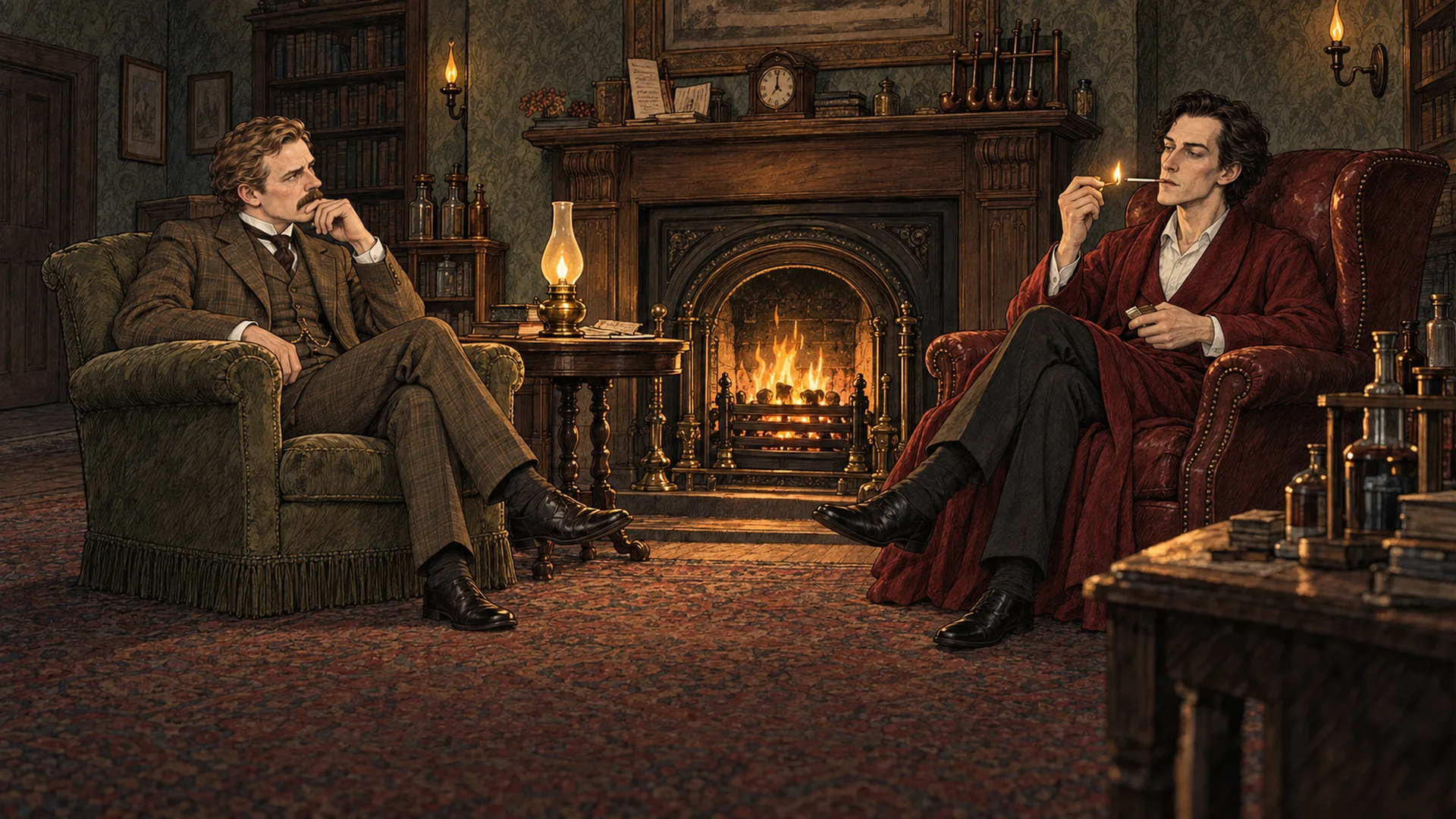
Watson laughs at the simplicity of Holmes’s explanation but admits he cannot reach the same conclusions himself. Holmes distinguishes seeing from observing. He asks about the staircase Watson has used hundreds of times, then asks how many steps it has. Despite his familiarity with the stairs, Watson does not know.
Japanese in this scene
- 笑わずにいられなかった
- Verb negative stem + ずにいられない means being unable to help doing something. The past ending なかった places this reaction in the narrated scene. Watson could not help laughing; he is not saying that he managed to avoid laughing.
- 説明してみせる
- Verb て-form + みせる means doing something so that another person can see or appreciate it. Holmes demonstrates his reasoning by explaining it. This is different from てみる, which means trying an action to see what happens.
- 見てはいるが
- Placing は after the て-form highlights a contrast: Watson does see the stairs, but does not observe them. Holmes repeats the pattern with the negative 観察してはいない. The two verbs describe different kinds of attention, not different eyesight.
- 何度も
- 何度 asks how many times. With も and a positive verb, 何度も means many times or repeatedly. Holmes then switches to 何段, asking the number of steps rather than how often Watson has seen them.
Background
- Cigarettes
- Although Holmes is strongly associated with a pipe, he also often smokes cigarettes and cigars in the original stories. In scene 4 he tossed Watson a cigar box; here he lights a cigarette for himself.
Full text: original English and Japanese translation
I could not help laughing at the ease with which he explained his process of deduction. "When I hear you give your reasons," I remarked, "the thing always appears to me to be so ridiculously simple that I could easily do it myself, though at each successive instance of your reasoning I am baffled until you explain your process. And yet I believe that my eyes are as good as yours."
推理の道筋をいとも簡単に説明してみせる彼に、私は笑わずにいられなかった。「きみが理由を説明するのを聞くと」と私は言った。「いつも馬鹿ばかしいほど簡単なことに思えて、自分にも楽にできそうな気がするんだ。ところが、きみが推理してみせるたびに、説明してもらうまではさっぱり分からない。それでいて、目のよさならきみに負けないと思うんだけどね」
"Quite so," he answered, lighting a cigarette, and throwing himself down into an armchair. "You see, but you do not observe. The distinction is clear. For example, you have frequently seen the steps which lead up from the hall to this room."
「そのとおり」と彼は答え、紙巻きたばこに火をつけて、肘掛け椅子にどさりと身を沈めた。「きみは見てはいるが、観察してはいない。その違いははっきりしている。たとえば、玄関からこの部屋へ上がってくる階段を、きみは何度も見ているね」
"Frequently."
「何度もね」
"How often?"
「何回くらいかね」
"Well, some hundreds of times."
「そうだな、何百回かな」
"Then how many are there?"
「では、何段あるかね」
"How many? I don't know."
「何段かって?知らないよ」