 よみうち英語Read the classics by typing
Notes Scene 8: The Pink Note
You've finished this scene
Notes on this scene
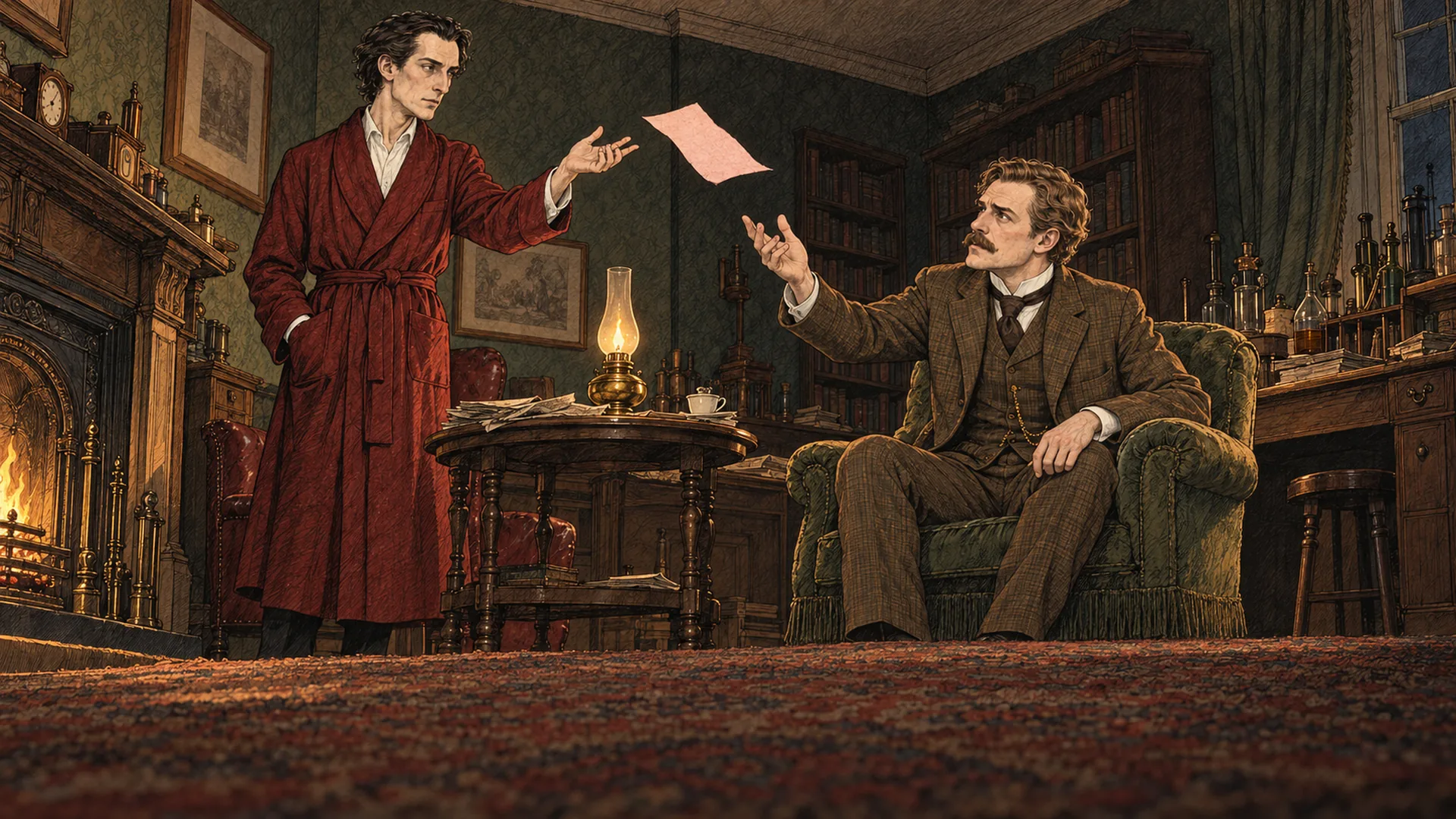
Holmes explains that he knows the staircase has seventeen steps because he has observed it. He then offers Watson a new puzzle: an unsigned note that arrived with the last post. Holmes asks him to read the thick pink notepaper aloud. The note also lacks a date and an address.
Japanese in this scene
- そこが肝心なところだよ
- ところ can mean a point or aspect as well as a physical place. Here そこ refers back to the difference between seeing and observing, and 肝心なところ identifies it as the crucial point. Holmes is emphasizing an argument rather than indicating part of the room.
- 記録してくれてもいる
- Verb て-form + くれる presents an action as a favor to the speaker. Watson records Holmes’s experiences, which Holmes appreciates. も adds that this is another reason Watson might be interested, alongside his existing interest in puzzles.
- 置いてあった
- Verb て-form + ある describes a state resulting from someone’s deliberate action. The paper has been laid out on the table, rather than simply happening to be there. あった places that arranged state in the past scene.
- 読んでくれたまえ
- This is a distinctly authoritative, old-fashioned way of asking someone to do something. たまえ follows the stem of the request verb くれる here. Holmes uses it with his familiar companion; it would not be an ordinary polite request in present-day conversation.
Background
- Several postal deliveries a day
- In Victorian London, post was delivered several times daily. A letter arriving with the evening’s “last post” was therefore unremarkable. Letters were used with an immediacy rather like email today.
- The seventeen stairs
- The seventeen steps Holmes says he has counted have become famous among readers. Their number is often discussed in attempts to recreate the rooms at 221B Baker Street.
Full text: original English and Japanese translation
"Quite so! You have not observed. And yet you have seen. That is just my point. Now, I know that there are seventeen steps, because I have both seen and observed. By the way, since you are interested in these little problems, and since you are good enough to chronicle one or two of my trifling experiences, you may be interested in this." He threw over a sheet of thick, pink-tinted notepaper which had been lying open upon the table. "It came by the last post," said he. "Read it aloud."
「そうだろう!きみは観察していないんだ。それでいて、見てはいる。そこが肝心なところだよ。さて、私は十七段あることを知っている。見て、しかも観察しているからだ。ところで、きみはこういうちょっとした謎に関心があるし、私のささやかな経験をひとつふたつ記録してくれてもいるから、これにも興味がわくかもしれないね」彼は、テーブルの上に広げて置いてあった厚手で淡い桃色の便箋を一枚、こちらへ放ってよこした。「最終便で届いたんだ」と彼は言った。「声に出して読んでくれたまえ」
The note was undated, and without either signature or address.
その手紙には日付がなく、署名も住所もなかった。