 よみうち英語Read the classics by typing
Notes Scene 12: A German Hand
You've finished this scene
Notes on this scene
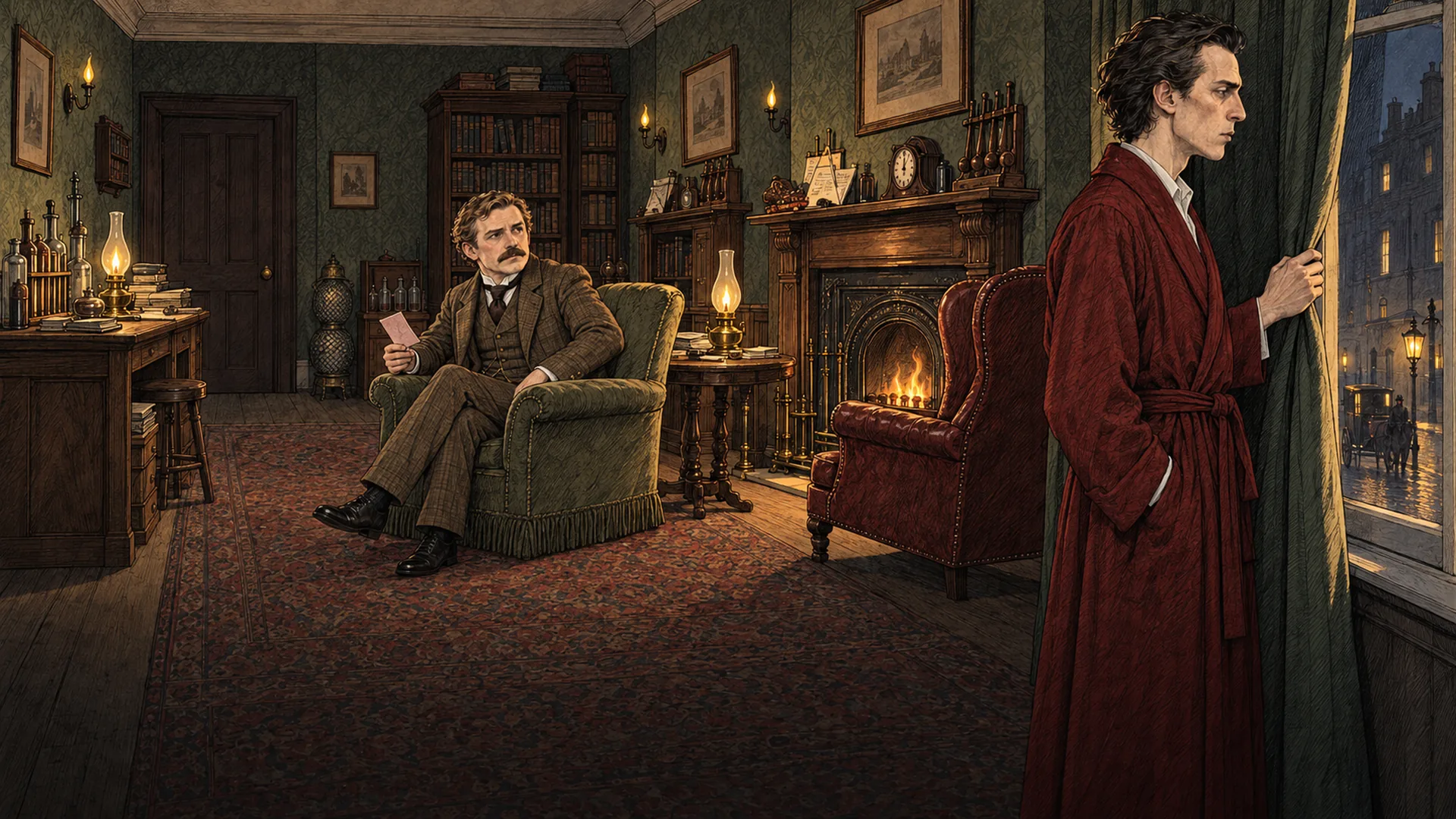
Holmes attributes the letter’s unusual sentence structure to a German writer. Having identified the paper’s origin and the writer’s nationality, he says the remaining question is what the masked visitor wants. The arrival of a carriage and the vigorous ringing of the bell suggest that the visitor is now at the door.
Japanese in this scene
- 書けない
- 書ける is the potential form of 書く, so 書けない means “cannot write.” Holmes is commenting on who would produce this particular sentence pattern, rather than saying that French or Russian people cannot write at all.
- つけたがる
- Verb stem + たがる describes another person’s apparent desire. Unlike たい, which directly expresses the speaker’s own wish in a statement, たがる presents desire as something observed or inferred. Holmes describes the caller’s preference for a mask.
- 思い違いでなければ
- 思い違い means a misunderstanding or mistaken impression. でなければ is the negative conditional of the copula: “if it is not ….” The whole expression means “unless I am mistaken,” introducing a conclusion with a small reservation.
- 解きにやって来た
- A verb stem followed by に before a verb of movement gives the purpose of that movement. 解きに means “to solve,” and やって来た means “has come.” Holmes imagines the caller arriving to resolve all their questions.
Full text: original English and Japanese translation
"Precisely. And the man who wrote the note is a German. Do you note the peculiar construction of the sentence—'This account of you we have from all quarters received.' A Frenchman or Russian could not have written that. It is the German who is so uncourteous to his verbs. It only remains, therefore, to discover what is wanted by this German who writes upon Bohemian paper and prefers wearing a mask to showing his face. And here he comes, if I am not mistaken, to resolve all our doubts."
「そのとおり。そして、手紙を書いた男はドイツ人だ。文の組み立てが妙なのに気づいたかね。『あなたについてのこの評判を、私どもはあらゆる方面から受け取っております』というところだ。フランス人やロシア人なら、あんなふうには書けない。動詞をこんなにぞんざいに扱うのは、ドイツ人なのだよ。したがって残るは、ボヘミアの紙に手紙を書き、顔を見せるより仮面をつけたがるこのドイツ人が、何を望んでいるのかを突き止めることだけだ。ほら、私の思い違いでなければ、その本人が疑問をすべて解きにやって来たようだ」
As he spoke there was the sharp sound of horses' hoofs and grating wheels against the curb, followed by a sharp pull at the bell. Holmes whistled.
彼がそう言ううちに、馬のひづめの鋭い音と、縁石にこすれる車輪のきしみが聞こえ、続いて呼び鈴が強く引かれた。ホームズは口笛を吹いた。