 よみうち英語Read the classics by typing
Notes Scene 48: Night at Baker Street
You've finished this scene
Notes on this scene
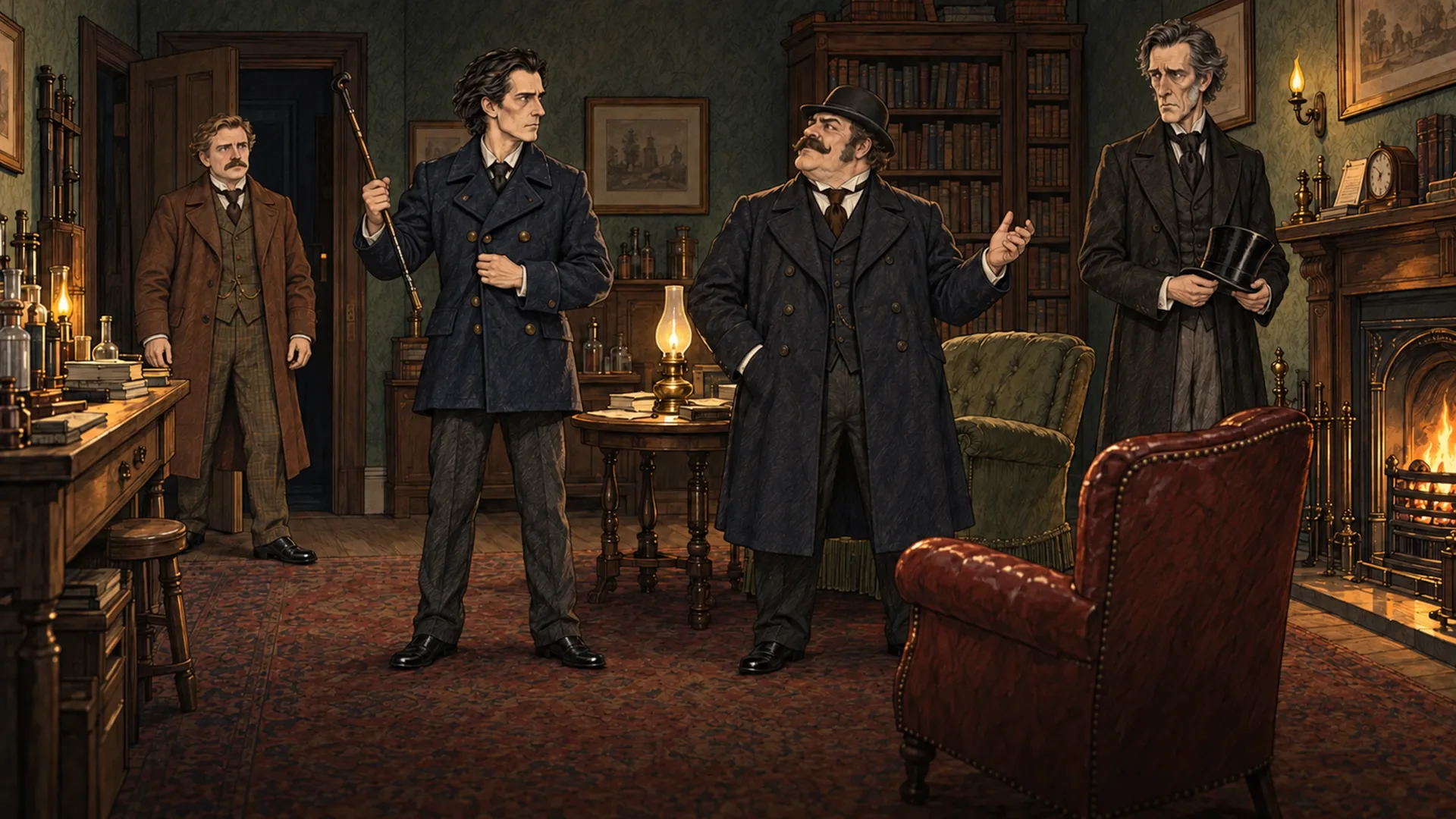
Watson leaves home at a quarter past nine and finds Holmes speaking with two visitors. One is the police officer Peter Jones; the other is a somber gentleman named Merryweather. Holmes finishes dressing for the expedition and explains that both men will accompany them in the adventure ahead.
Japanese in this scene
- ている
- The 〜ている form can show an action in progress, a continuing condition, or the present result of a completed action. The surrounding context selects the meaning.
- という
- という connects quoted words, a name, or an idea to the noun that follows. Depending on context, it can mean “called,” “that,” or “the idea that.”
- ほど
- ほど expresses degree or an approximate extent: “to the point that; as much as; about.” The comparison in the sentence determines its natural English rendering.
- と
- と after a complete statement can mark a quotation: “that….” It also means “with” between nouns, so the surrounding grammar matters.
Background
- Hansom cab
- A hansom was a fast two-wheeled cab for two passengers, with the driver seated high behind them. It was one of the most familiar forms of transport in Victorian London.
- Hunting crop
- A hunting crop is a short riding whip with a heavy handle. Holmes sometimes carries one for protection and can use it as an effective weapon.
Full text: original English and Japanese translation
It was a quarter-past nine when I started from home and made my way across the Park, and so through Oxford Street to Baker Street. Two hansoms were standing at the door, and as I entered the passage I heard the sound of voices from above. On entering his room, I found Holmes in animated conversation with two men, one of whom I recognised as Peter Jones, the official police agent, while the other was a long, thin, sad-faced man, with a very shiny hat and oppressively respectable frock-coat.
九時十五分に家を出た私は、公園を横切り、オックスフォード街を抜けてベイカー街へ向かった。戸口には辻馬車が二台止まっていて、廊下へ入ると、上から人の話し声が聞こえてきた。部屋に入ると、ホームズが二人の男と熱心に話し込んでいたが、一人は見覚えのある警察のピーター・ジョーンズ警部で、もう一人は背が高くやせた、悲しげな顔の男で、よく光る帽子に、息が詰まるほどきちんとしたフロックコートという身なりだった。
"Ha! Our party is complete," said Holmes, buttoning up his pea-jacket and taking his heavy hunting crop from the rack. "Watson, I think you know Mr. Jones, of Scotland Yard? Let me introduce you to Mr. Merryweather, who is to be our companion in to-night's adventure."
「よし!これで顔ぶれがそろった」とホームズは言い、ピージャケットのボタンを留めると、掛け台から重い狩猟用の鞭を取った。「ワトソン、スコットランド・ヤードのジョーンズ君は知っているね?こちらはメリーウェザーさん、今夜の冒険にご一緒いただく方だ」